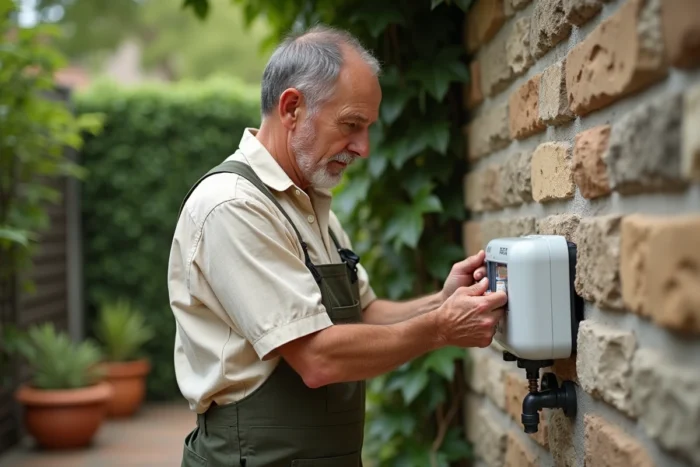
A battery-operated irrigation controller works thanks to low-power electronics powered by alkaline batteries, most often in AA or 9 V format. The lifespan of these batteries depends on several specific technical factors, from the frequency of irrigation cycles to the behavior of the controller in standby mode. Understanding these mechanisms allows for action on each of them to extend the replacement intervals.
Actual consumption of a battery-operated irrigation controller
The controller does not consume energy uniformly. Two phases can be distinguished: standby between cycles and the activation of solenoid valves. In standby, the controller maintains its internal clock and, on some models, refreshes an LCD screen. This consumption seems low, but it accumulates over months.
The activation of a solenoid valve represents the peak in consumption. Each valve opening activates a solenoid that requires a brief but significantly higher current than that of standby. Thus, multiplying the zones or daily starts accelerates battery depletion.
Recent models incorporate energy-saving modes (eco-mode, deep sleep) that reduce the frequency of screen updates and clock checks. This detail, rarely mentioned in selection guides, has a measurable impact on autonomy. A controller with a permanent display consumes more in standby than a model whose screen turns off after a few seconds of inactivity.
To extend battery life, it is advisable to first consult the opinion of lemagazinedubricoleur.fr on Easy Home which details the parameters of regular maintenance, and then check if the model used offers an energy-saving mode that can be activated in the settings.

Choice of batteries and impact on the controller’s autonomy
Not all alkaline batteries are created equal. The long-lasting ranges from major manufacturers offer higher energy density than entry-level options. This difference translates directly into additional weeks of operation in an irrigation controller.
Alkaline, lithium, or rechargeable batteries
- Standard alkaline batteries: the most common choice, they gradually lose their voltage. A controller that requires a minimum voltage threshold to operate the valve will stop functioning before the battery is completely discharged.
- Lithium batteries (AA format): they maintain a stable voltage longer and resist extreme temperatures better, making them suitable for irrigation boxes exposed to sunlight or frost.
- Rechargeable NiMH batteries: their nominal voltage is slightly lower than that of alkaline batteries. Some controllers do not recognize them properly and display a premature low battery signal. Check compatibility in the manufacturer’s manual before adopting them.
The battery format (AA or 9 V) is determined by the manufacturer. Controllers designed for AA batteries take advantage of the higher capacity of this format compared to 9 V, which is why AA-powered models generally show longer autonomy.
Programming settings that preserve batteries
The configuration of irrigation cycles has a direct influence on the electrical demand of the controller. Reducing the number of daily starts remains the most effective lever.
Group zones and limit starts
Each program start activates the solenoid of the corresponding valve. Grouping zones with similar water needs under the same program reduces the total number of activations. Three zones launched sequentially in a single program consume less than three distinct programs triggered at different times.
Seasonal adjustment is another factor. In autumn and spring, the frequency of irrigation can be reduced by half or even a third compared to summer. Adapting the programming to the season avoids unnecessary cycles that drain the batteries without benefiting the plants.
Disable unnecessary functions
Some controllers offer options like a rain delay or one-touch manual watering. Keeping the controller in simple automatic mode, without permanently activated additional functions, limits the micro-wakes of the processor. On models connected via Bluetooth or Wi-Fi, wireless communication represents an additional consumption point. Disabling Bluetooth between setup sessions can save several weeks of autonomy.
Low battery alerts and preventive replacement
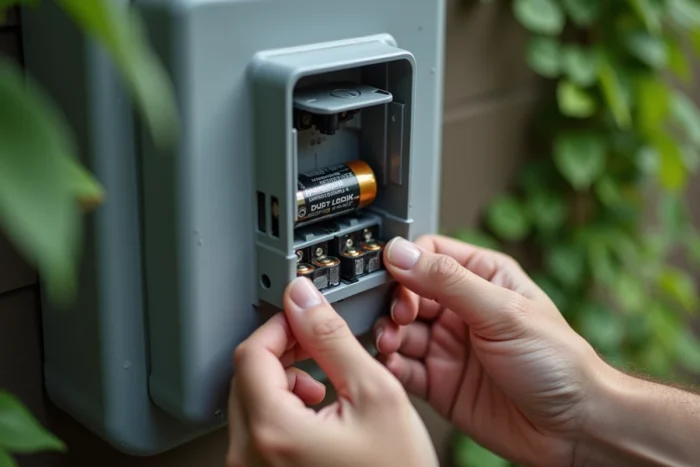
Allowing batteries to fully discharge in a controller poses two problems. The first is the interruption of irrigation, with a risk of water stress for the plants. The second concerns the batteries themselves: a deep discharge of alkaline batteries reduces the reliability of the next batch by sometimes leaving corrosive residues in the compartment.
In recent years, several brands of connected controllers have offered low battery alerts sent via mobile app, several weeks before the actual cutoff. This type of notification allows for preventive replacement that avoids both irrigation interruption and deep discharge cycles.
For non-connected models, a visual check of the battery level displayed on the screen, once a month during the irrigation season, is sufficient to anticipate replacement. Storing a set of spare batteries near the controller eliminates the risk of forgetting.
- Check the battery compartment at each change: clean the contacts with a dry cloth if any signs of oxidation appear.
- Remove the batteries at the end of the season if the controller remains inactive during winter, to avoid any electrolyte leakage.
- Store new batteries at room temperature, never in a case exposed to direct heat.
Choosing a controller with an eco-mode, combined with suitable batteries and adjusted programming, is the most reliable combination for extending replacement intervals. The most cost-effective action remains to remove the batteries off-season: a few seconds of handling that protect both the equipment and the autonomy of the next set.