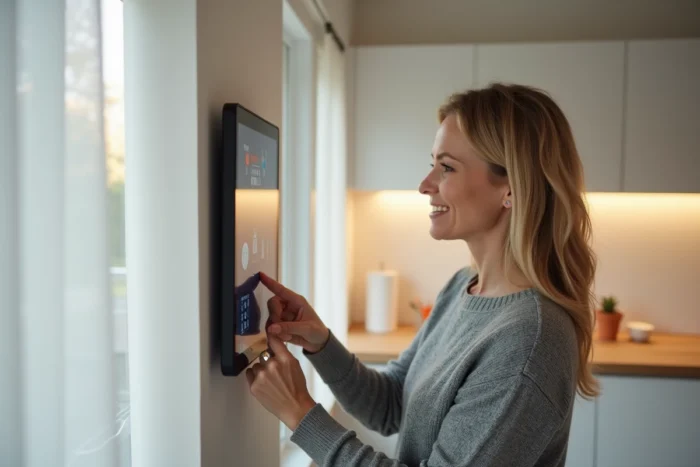
A radiator running at full blast in an empty room for eight hours, lights left on all night in the basement: we’ve all experienced these situations where the home consumes energy for no reason. Affordable home automation today allows us to correct these wastages without having to redo the electrical installation or invest unreasonable amounts. However, one must know where to start and which connected devices are truly worth their price.
Matter Protocol and Connected Devices: Why Compatibility Changes Everything
Before choosing a connected LED bulb or a thermostat, we often stumble upon the same issue: does the device work with the existing hub or voice assistant? Until recently, each manufacturer imposed its own protocol, which forced users to multiply gateways and applications.
The Matter protocol changes this logic. It allows devices from different brands to communicate with each other without additional proprietary bridges. In practical terms, a connected plug from manufacturer A can be controlled from the app of manufacturer B, provided that both are Matter compatible. This reduces the number of apps on the phone and prevents being trapped in a single ecosystem.
For those interested in concrete feedback on accessible equipment, home automation according to Votre Déco and Generationdomotique.com details several low-budget use cases that illustrate this progressive approach well.
When purchasing, simply checking for the mention “Matter” or “Works with Matter” on the packaging is sufficient. This reflex avoids unpleasant surprises and protects the investment in the long term, even if one changes voice assistants or home automation hubs later.

Room-by-Room Connected Heating: Home Automation That Really Reduces Energy Bills
Programming heating from an app is something everyone talks about. The approach that makes a difference is controlling room by room based on actual occupancy. A presence sensor in the living room turns off the radiator when no one is there. The office only heats during teleworking hours. The bedroom drops to a low temperature as soon as one wakes up.
This operation relies on connected thermostatic heads installed on existing radiators, and a central thermostat connected to the home automation hub. The installation requires no construction work: the manual head is replaced with the connected head in a few minutes.
Time Scenarios and Absence Detection
Time slots are configured to match the household’s routine. On weekday mornings, only the bathroom heats up. On weekends, the living room takes over earlier. In case of prolonged absence (vacation, travel), a “frost protection” mode activates automatically.
Feedback varies on this point depending on the insulation of the home and the type of heating, but the logic remains the same: only heat what is occupied, at the time it is occupied. This is where home automation has a measurable impact on energy consumption, much more than on lighting or shutters.
Connected LED Lighting and Shutters: Automate Without Overloading the Installation
Connected lighting is often the first home automation purchase. An LED bulb controllable from a Google assistant or an app is inexpensive and can be installed by simply screwing it in, without an electrician. The trap is accumulating too many without an overall logic.
The minimalist approach is to connect strategic light points:
- The entrance, with automatic lighting triggered by a motion sensor, so you no longer have to search for the switch with your arms full of groceries
- The living room, with a “movie night” scenario that dims the lighting and turns off unoccupied rooms with a single command
- The exterior (terrace, garage), with a timed schedule aligned with sunset for security without waste
For roller shutters, a connected motor can be installed on existing shutters in most cases. Automatic closure at sunset improves thermal insulation in winter and limits overheating in summer, without daily intervention.
Centralizing Home Automation Control: Hub, App, and Switches
Multiplying connected objects without centralization creates more of a problem than a solution. You end up with five apps on your phone, overlapping scenarios, and a partner who refuses to use the system.
The current trend is towards a more streamlined architecture:
- A single home automation hub that consolidates all protocols (Zigbee, Z-Wave, Matter) and serves as the central brain
- A single management app to control lighting, heating, and shutters from the same screen
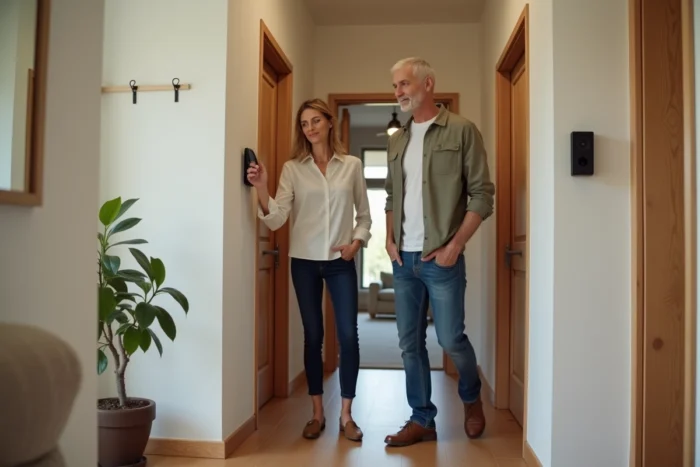
- Connected wall switches that allow everything to be controlled even without a phone, which reassures household members who are less comfortable with technology
This centralization also avoids a common pitfall: obsolescence through fragmentation. When each device depends on its own gateway, a manufacturer that stops its cloud service renders the device unusable. With a local hub and the Matter protocol, you maintain control even if a brand disappears.
Home Automation and Supporting Seniors at Home
A less publicized but rapidly growing use concerns assistance for the elderly. Motion sensors placed in main rooms can detect abnormal inactivity and send an alert to a relative. Combined with automatic lighting at night (hallway, bathroom), these devices reduce the risk of falls without turning the home into a medical environment.
The connected home does not need to be spectacular to improve daily comfort. Three or four well-chosen devices, compatible with each other and controlled from a single interface, are enough to eliminate wastage and simplify repetitive tasks. A modest system that works every day is better than an ambitious installation that no one uses.