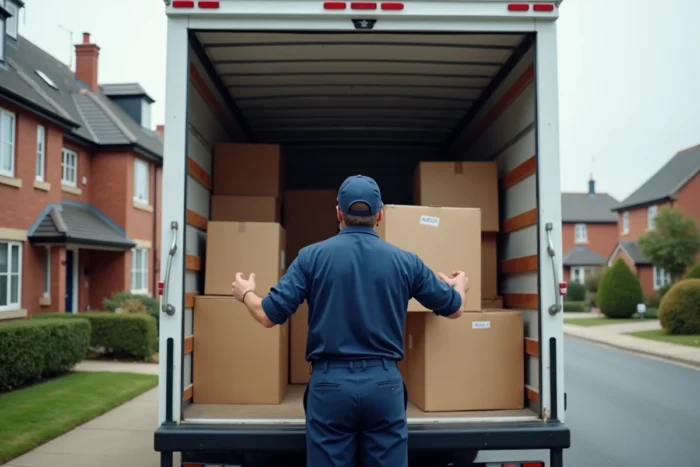
A 10 m3 truck remains the most rented format by individuals moving a studio or a small two-room apartment. Behind this announced volume lie weight, size, and regulatory constraints that most renters discover on the day of loading. The useful volume does not tell the whole story: the payload, interior dimensions, and access restrictions in the city weigh just as heavily on the success of a transport.
Payload of a 10 m3: why volume is not enough
Renting a 10 m3 van means having a loading space of about ten cubic meters. However, filling this space to the ceiling does not guarantee compliance with regulations.
The limit that really matters is the payload, which is the difference between the total authorized weight (PTAC) and the empty weight in working order. For a van in this category, it generally hovers around one ton, sometimes a little less.
A detail often overlooked: to know what a 10 m3 truck can carry, you need to check box G1 (empty weight) and box F2 (PTAC) on the registration document of the rented vehicle, not just the rental company’s commercial sheet.
Recent compact vans (Renault Trafic, extended Peugeot Expert, VW Transporter) have seen their actual payload decrease since the introduction of the Euro 6d standard. The addition of AdBlue systems, driving aids, and structural reinforcements eats away several dozen kilos compared to versions before 2020. On a vehicle whose payload already hovers around one ton, losing thirty or forty kilos can tip a load into overload.
Interior dimensions of the 10 m3 truck and bulky items
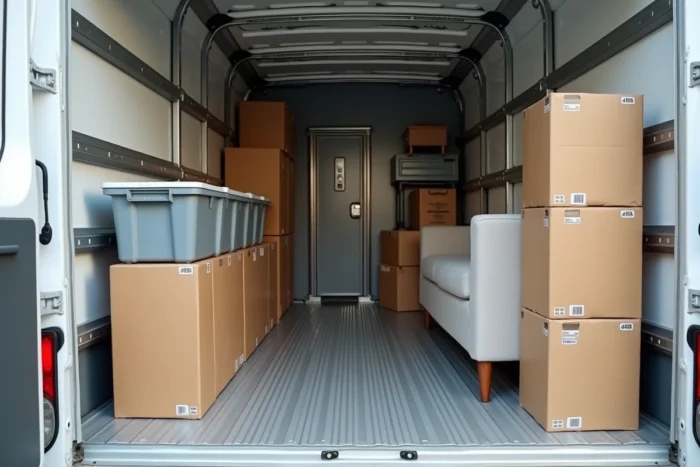
The gross volume of 10 m3 corresponds to a loading space whose length varies by model, with a width and height that allow most studio furniture to slide in. In practice, a double bed, a two-seater sofa, a refrigerator, a washing machine, and about twenty standard boxes fit within this size.
What fits and what gets stuck
Flat furniture (mattresses, bed bases, disassembled tables) stacks easily along the walls. Tall and rigid objects pose more problems: a non-disassemblable wardrobe or a massive sideboard can block access to the back of the truck and waste useful volume.
- An L-shaped sofa in several modules fits without difficulty, but a monobloc L-shaped sofa often exceeds the width of the rear door.
- An American refrigerator (double door type) rarely fits: its width exceeds that of the opening of most 10 m3 vans.
- Boxes of books are heavy for their size, which means reaching the weight limit before the volume limit.
The basic rule: load heavy and flat items on the floor, against the partition, then stack light boxes on top. Poor arrangement can easily waste one or two cubic meters of usable space.
Transporting materials and bins: regulatory limits of the 10 m3
The 10 m3 is not reserved for moving. Craftsmen and individuals use it to transport building materials, rubble, or garden furniture. The question of weight then becomes central.
A few bags of cement or plaster are enough to approach the maximum payload. Building materials are dense: the volume available in the bin or loading space remains largely underutilized when reaching the authorized weight limit.
Penalties for overload
A roadside check revealing an exceedance of the PTAC exposes the driver to a fine, as well as to the immobilization of the vehicle. The mechanical consequences are just as concrete: longer braking distances, risk of tire blowouts, premature wear of axles and suspension.
For professionals who regularly transport heavy materials, a vehicle with a tipping bin or a van with a higher PTAC is more suitable than a standard 10 m3 van.
Low emission zones and city access for a 10 m3 van
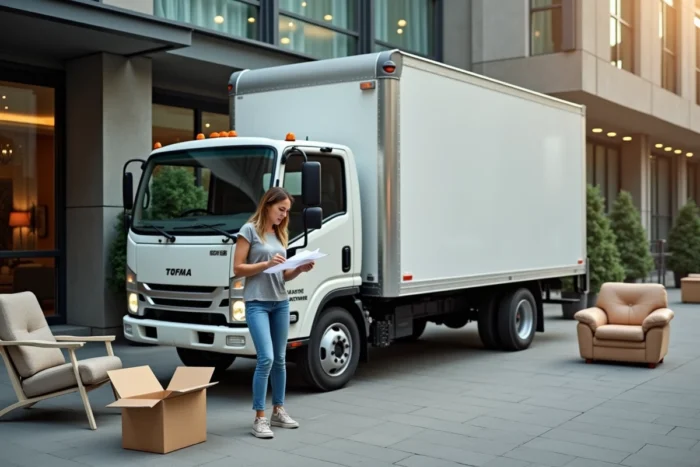
The choice of vehicle is no longer limited to volume and weight. Since the deployment of Low Emission Mobility Zones (ZFE-m), several French metropolitan areas restrict access for diesel vans based on their Crit’Air sticker. Lyon, Grenoble, and Strasbourg have already enacted or planned the exclusion of certain light commercial vehicles.
An old diesel 10 m3 (Crit’Air 3 or higher) can no longer access the center of these urban areas freely. For an intra-urban move, this constraint requires checking the sticker of the rented vehicle before signing the contract.
The electric option and its trade-offs
Manufacturers now offer electric versions of their 10 m3 vans. The loading volume remains comparable to that of thermal versions. However, the weight of the batteries significantly reduces the payload compared to an equivalent diesel. The range, often limited to a few hundred kilometers in real conditions, also restricts the operating radius for long trips.
For a local move in a ZFE-m, the electric 10 m3 addresses the access issue. For a loaded interurban trip, field returns vary on the actual capacity to complete the journey without intermediate recharging.
Before reserving a 10 m3 truck, three checks should be made in this order: the payload listed on the vehicle’s registration document, the Crit’Air sticker if the route crosses a ZFE-m, and the width of the rear door if the load includes a bulky non-dismantlable piece of furniture. The volume announced by the rental company is a starting point, not a guarantee of feasibility.