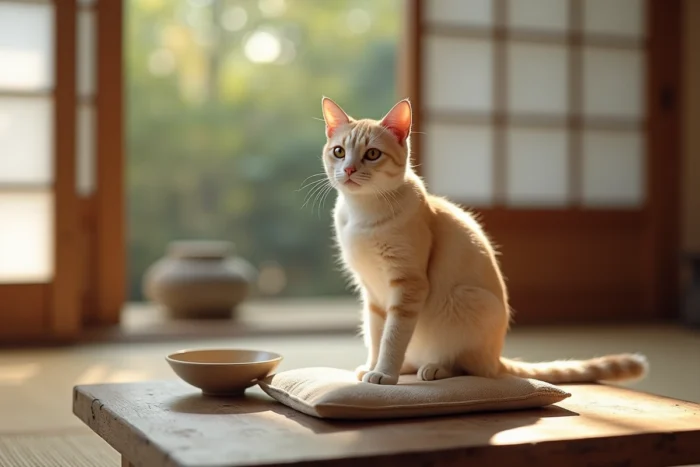
When adopting a beige and white cat, one quickly faces surprising remarks. A neighbor sees it as a good luck charm, a friend talks about calming energy, another mentions ancient Egypt. The color of a feline’s coat carries a symbolic baggage that varies radically from continent to continent, and the beige-white mix is no exception.
Beige and White Coat: What Genetics Says (and Doesn’t Say) About Character
It is often said that a cat’s coat influences its temperament. A ginger would be playful, a black one mysterious, a bicolor balanced. In practice, the color of the coat does not determine the cat’s character. Personality associations stem from cultural or personal beliefs, not from a veterinary consensus.
What is certain, however, is the genetic mechanism. Cream or beige tones result from a dilution of melanin, the same pigment that produces the more intense ginger. White comes from a distinct gene that prevents pigmentation in certain areas of the body. When exploring the meaning of the beige and white cat, one understands that this genetic combination creates a unique bicolor pattern for each individual, much like a fingerprint.
The piebald gene, responsible for the white/color distribution, acts randomly. Two kittens from the same litter can have completely different white distributions. No breeder can guarantee a specific pattern. It is this unpredictable nature that has likely fueled, over the centuries, all sorts of symbolic interpretations.
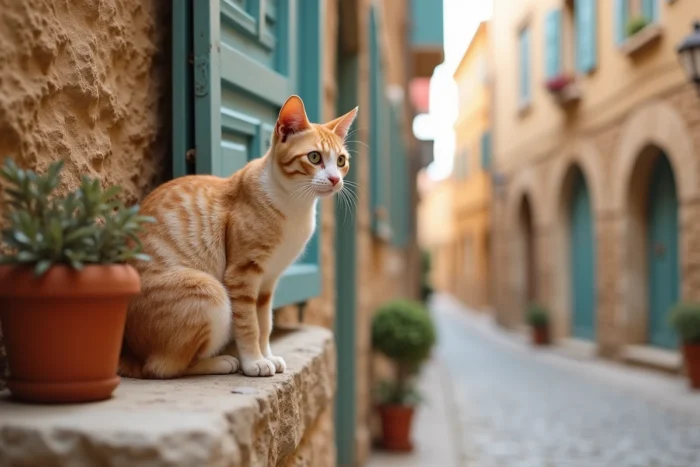
Symbolism of the Beige and White Cat in Asia and the Middle East
In Japan, the cat is a full-fledged family member. The maneki-neko, the cat with the raised paw found at the entrance of shops, comes in several colors. The light versions (white, cream) are associated with purity and luck. A domestic cat with a pale coat receives a benevolent gaze in Japanese households.
In China, the cat has historically been a symbol of peace. The soft shades of beige reinforce this interpretation. A feline with light colors is believed to bring calm energy into the home, in contrast to the black cat, which arouses more suspicion in certain regions.
The Arab World and the Protected Cat
In Islamic tradition, the cat enjoys a special status. Several stories mention the respect owed to this animal. Light-colored cats are seen as protective presences in many households in the Middle East. The beige and white combination, with its sandy tones, recalls desert landscapes and fits naturally into the visual universe of these regions.
European Beliefs Surrounding the Light Bicolor Cat
In Europe, superstitions surrounding cats mainly focus on black ones. The beige and white cat largely escapes these negative prejudices. In Russia, the cat is even seen as a domestic good luck charm, regardless of its coat. Sometimes a kitten is given as a housewarming gift to protect the new home.
In the French and British countryside, bicolor cats have historically been appreciated for their role as hunters in barns. The color of the coat mattered less than effectiveness. Feedback varies on this point, but some local traditions attributed to light-colored cats a better ability to spot rodents at night, in contrast to their dark surroundings.
Contemporary Esotericism and Cream Tones
In current esoteric circles, the meanings of white and beige are distinguished quite precisely:
- White is associated with purity, peace, and spiritual protection of the home
- Beige or cream is interpreted as a marker of softness, emotional stability, and calming energy
- The combination of the two produces a so-called “balancing” symbolism, more nuanced than that attributed to solid-colored cats
A beige and white cat would carry a dual energy of calm and purification. This interpretation is not scientific, but it concretely influences the choice of some adopters who seek a companion in tune with their sensitivity.
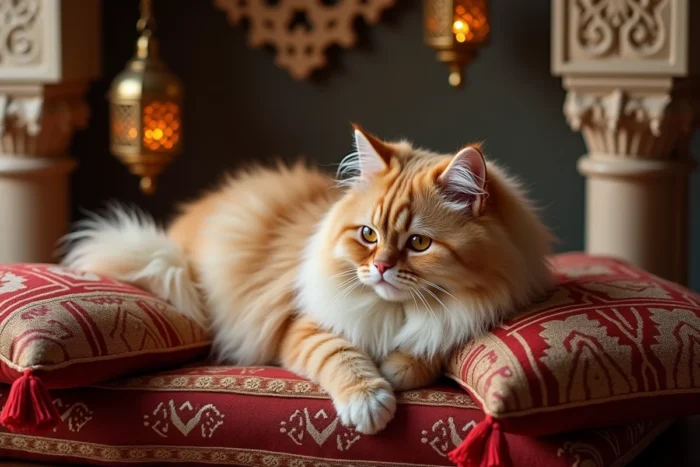
Beige and White Coat: Patterns, Breeds, and Variants to Know
Not all beige and white cats look alike. The bicolor pattern varies according to breed and individual genetics. Some breeds more frequently exhibit this combination:
- The British Shorthair in its cream and white variant, with dense fur and a thick undercoat
- The Ragdoll, whose colored extremities contrast with a lighter body
- The Turkish Van, often white with color patches limited to the head and tail
- The bicolor alley cat, by far the most common and varied in its patterns
The technical term for describing the white/color distribution is “bicolor” or “particolor” coat. When white predominates, it is sometimes referred to as a “van” cat (in reference to the Turkish Van). When the color patches are more extensive, the term “harlequin” is used.
What the Eyes Reveal in Addition to the Coat
In cats with a dominant white coat, the eye color attracts as much attention as the coat. Blue or odd-colored eyes are more common in cats with a high percentage of white, due to the same depigmentation mechanism. This peculiarity adds an extra layer to the symbolism: in several cultures, odd-colored eyes are seen as a sign of luck or clairvoyance.
The beige and white cat traverses eras and continents with a generally positive image. Where the black cat divides, the light bicolor brings together. Its genetics produce a unique coat for each individual, and human cultures project protection, softness, or balance onto it in turn. The one point on which everyone agrees: adopting a cat, regardless of its coat, transforms a dwelling into a home.