
When searching for information on a veterinary medication, a vaccination protocol, or a batch reminder, the classic approach involves navigating between several scattered websites, tabs, and PDFs. An online space dedicated to veterinary resources changes this habit by bringing together product sheets, animal health data, and tracking tools in a single interface. However, it is essential to understand what these platforms actually offer and what they cannot do.
What an online veterinary space does not replace
Before discussing the features, one point deserves to be made clear. Veterinary teleconsultation remains legally limited in France. The experiment regulated by the decree of May 5, 2020, ended in November 2021. There is currently no permanent framework that allows for the generalization of remote diagnosis or prescription.
An online space dedicated to veterinarians or pet owners does not replace physical consultations. Its role lies elsewhere: organizing access to technical sheets, centralizing tracking documents, facilitating appointment scheduling, or renewing ongoing treatments.
This distinction between medical acts and document management is the first thing to check when evaluating a platform. If a service promises an online diagnosis for your dog or cat, it operates in a legally ambiguous area. Reliable spaces clearly separate advice, document tracking, and veterinary acts.
Centralized animal health sheets and documentary resources
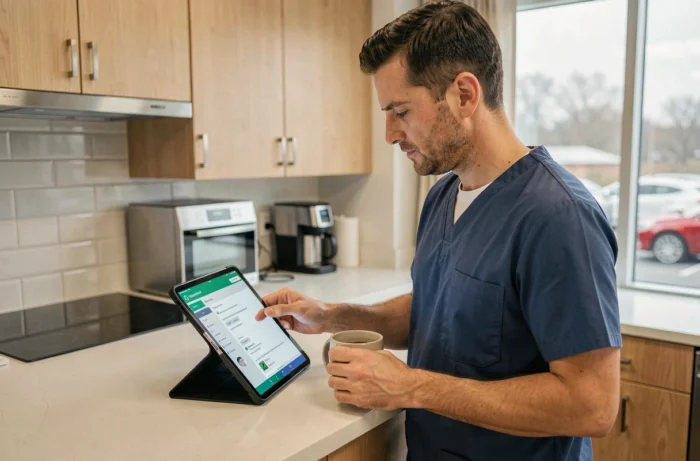
The first concrete benefit of a dedicated space is no longer having to search for a product sheet for ten minutes. Have you ever noticed that the leaflets for veterinary medications are rarely found in the same place as vaccination protocols or health alerts? A well-designed portal brings these elements together.
For professionals in the clinic, this means quickly consulting the data on a parasitic treatment, checking a dosage, or retrieving an order history. For pet owners, the interest lies more in the digital health record, vaccination reminders, and prevention sheets.
Some spaces go further by offering news filtered by species (dog, cat, other pets). Instead of receiving a generic feed, the veterinarian or owner accesses targeted content. This personalization reduces informational noise, which is appreciated when managing multiple animals or clients.
You can access the Espace Animaux site to see how this type of centralization works in practice, with a portal that brings together login, resources, and veterinary services.
Client data protection and animal health: points to check
An animal file may seem innocuous. In reality, it often contains the owner’s name, contact details, and sometimes their I-CAD number. This personal data falls under GDPR as soon as it allows for the identification of an individual.
Why does this point matter? Because an online veterinary space that stores this information must comply with several concrete obligations:
- Limit data collection to what is strictly necessary for the advertised service (no forms asking for everything and anything)
- Define clear retention periods for animal health records and client contact details
- Provide contractual oversight of the technical provider hosting the platform
- Allow clients to exercise their rights of access, rectification, and deletion
- Have a documented procedure in case of data breaches
An additional technical criterion applies when the platform hosts health data on behalf of a third party. The HDS certification (Health Data Host) must then be verified. The HDS v2 reference framework, applicable to new audits since May 16, 2024, strengthens the requirements for hosting within the European Economic Area.
In practice, before creating an account on a veterinary space, look for the mention of the host in the terms of use or privacy policy. The absence of this information is a warning sign.
Useful features for managing your veterinary services on a daily basis
Not all online spaces are created equal. Some are limited to an appointment scheduling agenda. Others integrate a real management ecosystem. Here are the features that truly make a difference on a daily basis.
Digital health record and automatic reminders
A dematerialized health record allows for tracking vaccinations, parasitic treatments, and surgical interventions for each animal. Automatic reminders reduce missed vaccinations, benefiting both the veterinarian (who retains their clientele) and the owner (who protects their animal).
Multi-profile access for the clinic team
In a clinic with multiple veterinarians and assistants (ASV), a well-designed space offers differentiated access levels. The practitioner consults and modifies medical records. The ASV manages appointments and orders. The manager accesses financial data.
This separation of roles is not an organizational luxury. It directly meets the requirements of minimizing access to personal data imposed by GDPR.
Synchronization with existing tools
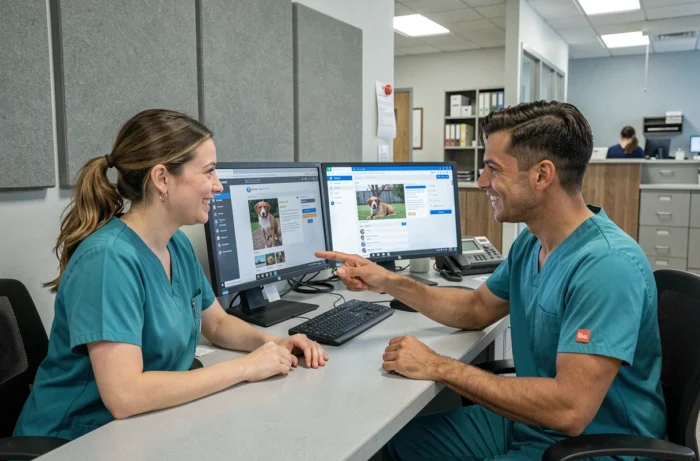
A useful online space integrates with tools already in place: clinic management software, shared calendars, billing systems. Without this compatibility, the platform becomes just another tool to maintain rather than simplifying work.
Choosing an online veterinary space: three decisive criteria
Instead of comparing a dozen secondary features, focus your evaluation on three points.
- Legal transparency: accessible terms of use, mention of the host, detailed privacy policy. If these documents are absent or vague, move on
- A clear distinction between information and medical acts: the space should not imply that it replaces a clinic consultation
- Technical interoperability: the platform must be able to exchange data with your existing management software without manual re-entry
A reliable space clearly displays its limits rather than promising a universal solution. Paradoxically, this is the best indicator of seriousness: a platform that tells you what it does not do deserves your trust more than one that claims to handle everything.
The animal health sector is gradually digitizing, but this transition remains framed by specific regulatory constraints. Checking these three criteria before creating an account will help you avoid entrusting your clients’ or animals’ data to a service that does not protect them properly.