
Disparity is not limited to a statistical gap between two averages. It refers to a measurable structural differential between groups or territories, which persists even when macroeconomic indicators improve. We observe that mainstream analyses often confuse disparity, inequality, and discrimination, while each term refers to a distinct mechanism.
Territorial Disparity in France: Overcrowding of Housing and Access to Healthcare
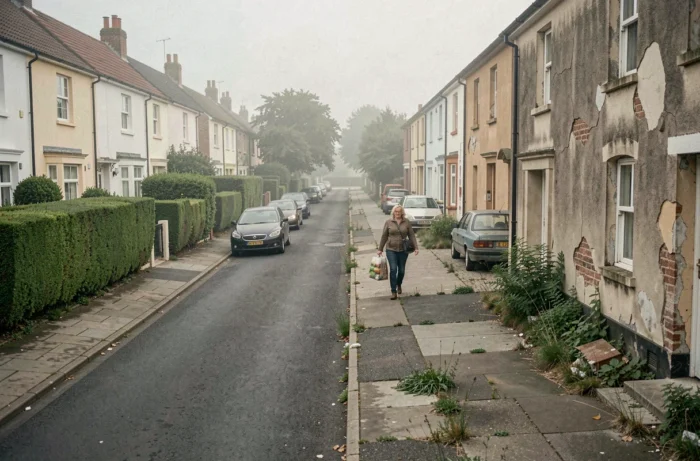
The gaps in living conditions between French territories represent the least addressed angle in analyses focused on social classes or gender. Data from Insee published in September 2026 reveal a concentration of housing overcrowding in Guyana, Paris, and Seine-Saint-Denis, while potential access to general practitioners varies significantly from one living area to another.
This type of disparity cannot be corrected by a general increase in income. A household whose salary increases in an area lacking healthcare services does not see its health situation improve as a result. Territorial disparity acts as a multiplier: it amplifies pre-existing socio-economic gaps.
To learn everything about disparity in its broadest dimensions, this geographical perspective must be integrated into the usual analytical frameworks. Without it, corrective policies target symptoms (income, employment) without addressing structural causes (healthcare network, housing density, transport infrastructure).

Persistent Poverty and Income Disparity: Distinguishing the Temporary from the Structural
A recent publication from Insee highlights that episodes of poverty are more persistent than typically measured. Material and social deprivation remains significant in early 2025, even for households that do not fall below the monetary poverty threshold.
We recommend distinguishing three situations that traditional indicators amalgamate:
- Temporary poverty, linked to an accident in life (job loss, separation), which resolves within a few quarters when social safety nets function.
- Sustainable poverty, where the household remains below the threshold for several consecutive years, with an erosion effect on social capital and health.
- Gradual degradation of living conditions, invisible in monetary statistics, where income stagnates while constrained expenses (housing, energy, food) increase.
This third category explains why disparity can increase without the official poverty rate changing. Traditional measurement tools poorly capture this silent shift.
Pay Transparency and Gender Disparity: The 5% Threshold
The draft law presented in the Council of Ministers on September 10, 2026, transposes the European directive on equal pay. The central mechanism: mandatory correction when the pay gap exceeds 5% without objective justification.
This 5% threshold changes the burden of proof. Until now, the burden largely rested on the employee who had to demonstrate discrimination. With pay transparency, it is the employer who must justify the gap beyond the threshold.
Expected Effect on Classification Grids
Companies will need to review their job classification systems. A different job title for identical functions will no longer suffice to justify a pay gap. We anticipate a cascading effect: transparency on salaries will mechanically highlight disparities in access to bonuses, overtime, and promotions.
Gender pay disparity is not limited to base salary. It resides in additional compensation, benefits in kind, and career trajectories. The legislative text opens a lever, but its effectiveness will depend on the granularity of the data published by companies.
Cumulative Factors of Disparity: Social Class, Age, and Origin
The Insee Employment survey illustrates how factors of disparity combine. Social category, age, and origin do not simply add up: they multiply.
This intersection phenomenon complicates the design of public policies. A measure targeting only the social category (employment aid for workers, for example) does not correct the overexposure to unemployment linked to age or origin. Conversely, a policy focused on origin without considering social class misses the underlying economic mechanisms.
Multifactorial Analysis: A Methodological Necessity
Cross-tabulations by class, age, and origin remain rare in institutional publications. Most public barometers continue to treat each factor in isolation. This analytical fragmentation produces incomplete diagnostics and partial political responses.
- Income-only analysis masks disparities in access to public services (health, education, transport).
- Gender-only analysis ignores the massive gap between female executives and female workers.
- Territory-only analysis does not capture the dynamics of residential segregation within the same geographical area.
Treating disparity as a phenomenon with multiple entries, rather than a series of independent gaps, remains the main methodological challenge for the coming years. The tools exist; it is their systematic use in public decision-making that is lacking.