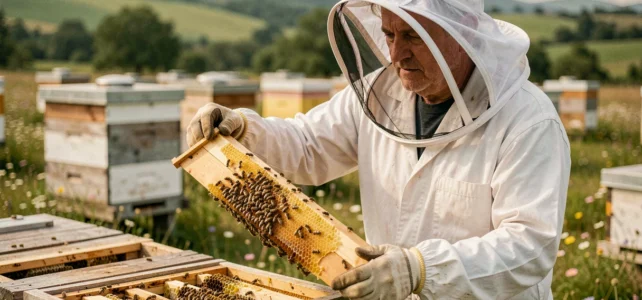
Artisanal honey is not just a sweetening product. Its composition varies according to the foraged flora, the timing of the harvest, and especially the technical choices of the beekeeper, from the management of the apiary to the extraction. Understanding these parameters allows one to distinguish between living honey and a standardized product whose nutritional value has been leveled by pasteurization or blending of origins.
Honey Labeling and New Traceability Obligations
French regulations on honey labeling were tightened in 2025. Blends must now indicate the country of origin in descending order of proportion. Generic mentions such as “blend of EU and non-EU honeys” are no longer sufficient.
This evolution changes the game for consumers. Before this regulation, a jar could contain a majority of Chinese or Argentine honey without the label clearly stating so. Now, the hierarchy of origins is readable, making the comparison between artisanal French honey and industrial blends much more transparent.
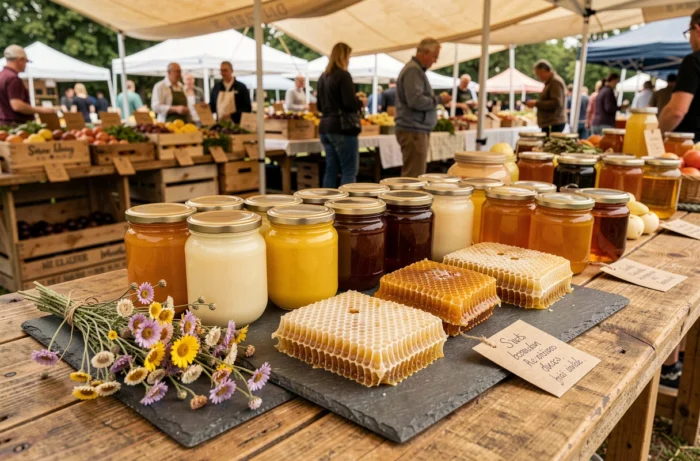
For French beekeepers, this is a differentiation lever. Honey harvested from an identified terroir, cold-extracted, and jarred without blending naturally carries a traceability that import supply chains struggle to document. Resources like hommesetabeilles.fr testify to this direct relationship between the beekeeper, their hives, and the final consumer.
Apiary Management: What Determines the Quality of Artisanal Honey
Quality honey is determined at the apiary, not at the jarring stage. The choice of hive location conditions the available floral palette and thus the aromatic profile of the honey. An apiary placed on the edge of a monoculture of rapeseed will produce homogeneous honey, while an apiary located in a fallow area or mixed forest will yield a more complex polyfloral honey.
The health management of the colony plays a direct role. An artisanal beekeeper monitors the health status hive by hive, adapts treatments against varroa to the queen’s laying schedule, and avoids molecules that migrate into the wax and then into the honey. This individualized approach is incompatible with intensive production logic.
The harvest itself follows precise technical decisions:
- The moisture content of the honey in the frames must remain below a strict threshold to avoid fermentation. The beekeeper waits until the bees have capped the majority of the cells before removing the supers.
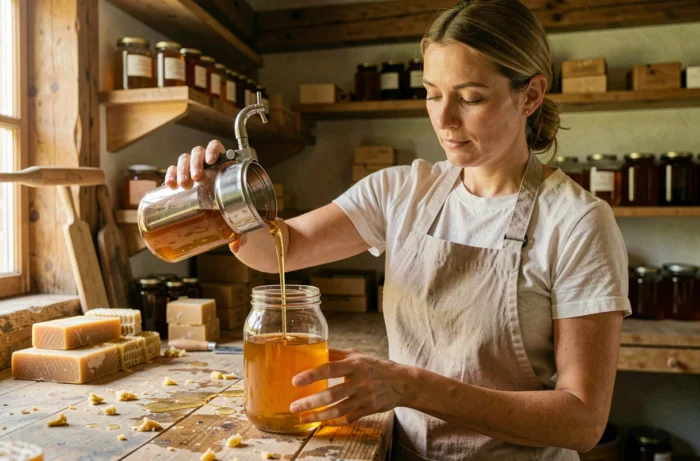
- Cold extraction, through slow centrifugation, preserves heat-sensitive enzymes (diastases, glucose oxidase) that disappear during industrial heating.
- Maturation in barrels allows micro-bubbles of air and impurities to rise naturally, without pressure filtration that depletes the honey of pollens.
These steps require time. We observe that most artisanal honeys are only available several weeks after the harvest, whereas an industrial circuit puts products on the shelves within days following extraction.
Climate Pressure on Beekeeping Production in 2026
The French beekeeping sector is experiencing significant climate pressure in 2026. Several regions report production declines related to drought, with drops described as reaching about one-third of the usual harvest in certain areas.
The mechanism is direct. When soils dry out, plants reduce or stop their nectar secretion. Bees return empty, consume their own reserves, and enter survival mode. The beekeeper faces a dilemma: harvest little or not at all to leave the colonies enough to survive the winter.
This context partly explains the scarcity of certain French monofloral honeys. A lavender or chestnut honey whose flowering has been cut short by heat becomes rarer, thus more expensive. The price of artisanal honey reflects the reality of a harvest subject to climatic hazards, not an arbitrary commercial margin.
Hive Declaration and Regulatory Framework for Starting Beekeeping
The declaration of hives remains mandatory from the first hive, even for an amateur beekeeper. The procedure has been simplified with the issuance of an immediate receipt and the assignment of a NAPI number, a unique identifier for the apiary.
This number must be displayed on a visible sign near the apiary. It allows veterinary services to ensure health monitoring and trigger alerts in case of a pathogenic outbreak in the area. Neglecting this formal requirement exposes one to penalties, but more importantly, deprives the beekeeper of departmental health support.
Beyond the declaration, starting beekeeping requires an investment in appropriate equipment (hives, frames, smoker, suit) and practical training. Departmental beekeeping unions offer school apiaries where learning occurs in direct contact with the colonies, over a complete seasonal cycle. Handling brood frames is not something that can be improvised, and beginner mistakes (too frequent openings, poor feeding) can jeopardize the survival of a colony.
Artisanal Honey and Biodiversity: A Technical, Not Symbolic Link
The pollination provided by bees is not just a superficial ecological discourse. Each colony covers a foraging radius of several kilometers and visits thousands of flowers each day. This activity benefits vegetable crops, orchards, and the surrounding wild flora.
An artisanal beekeeper who maintains their hives in a diverse environment contributes to the preservation of ecological corridors. In return, floral biodiversity enriches the composition of their honey with varied pollens, resulting in a richer organoleptic profile and a more diverse micronutrient content.
The relationship is circular: a territory rich in biodiversity produces better honey, and beekeeping activity reinforces that biodiversity. Farms that combine beekeeping with the preservation of hedges, meadows, or wetlands concretely illustrate this virtuous circle, far from mere slogans.
The next time you compare two jars of honey on the shelf, look at the label. The origin, extraction method, and beekeeper’s name say more than any marketing claim.