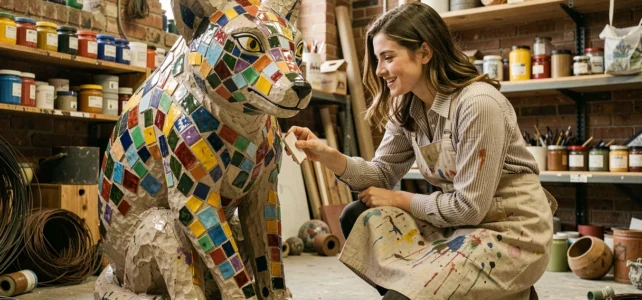
The expression “enfants terribles” refers, in the cultural field, to a galaxy of proposals that share a common trait: the refusal of the formatted. Textless albums, performances blending storytelling and music, workshops where making replaces passive consumption. Measuring what distinguishes these creative approaches from more conventional offerings requires comparing their formats, audiences, and modes of participation.
Offbeat cultural formats for children: comparative table of approaches
The proposals labeled “offbeat” do not boil down to a single genre. They cover a spectrum ranging from illustrated albums to digital making workshops, including participatory performances. The table below contrasts three common formats and their measurable characteristics.
| Format | Average session duration | Child’s role | Main medium |
|---|---|---|---|
| Offbeat children’s album (textless or with visual humor) | Free reading, frequent rereading | Active interpreter of illustrations | Paper, colors, non-linear layout |
| Narrated and sung performance (type cruel musical tale) | About 50 minutes | Engaged spectator, sometimes called upon vocally | Voice, live instruments, puppets |
| Creation workshop (design, digital arts, making) | Variable depending on the setup | Creator, co-designer | Physical materials or digital tools |
The main difference lies in the role assigned to the child. A textless album allows the young reader to construct the narrative from the illustrations alone. A performance like Cruelles histoires d’enfants terribles by Tony Havart places cunning and humor at the center, with musical accompaniment (gospel, raggamuffin, reggae) that transforms the narrative into a sensory experience.
The proposals put forth by Enfants Terribles fit into this logic of a creative universe where offbeat imagination takes precedence over classic linear storytelling.
Children’s albums and offbeat illustrations: what changes reading
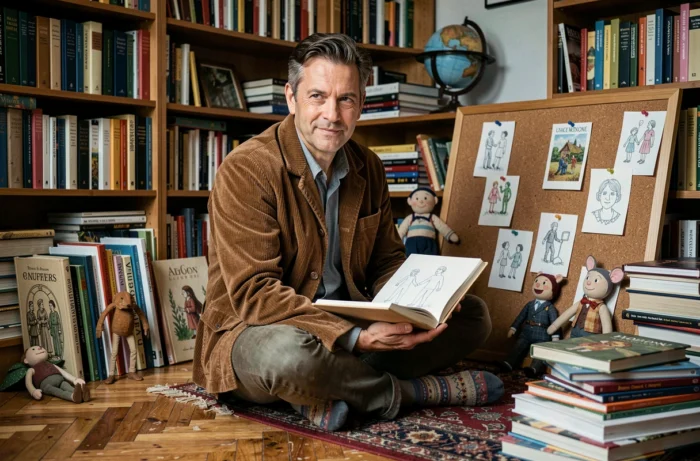
In children’s publishing, the offbeat nature does not lie in the subject matter but in how the page functions. An album where the illustrations carry the story without text forces the child to verbalize, invent dialogues, and go back to check a visual detail.
This mechanism calls for different skills than classic reading:
- Fine observation of colors and character expressions replaces word decoding, making the book accessible well before learning to read.
- Visual humor (absurd situations, graphic falls) creates a playful relationship with the book-object, distant from school logic.
- Rereading produces different interpretations with each pass, as the child projects their own experiences onto deliberately open images.
In contrast, a classic texted album guides understanding through written narration. The textless album delegates the construction of meaning to the reader, regardless of their age. This distinction is not trivial: it conditions the child’s posture towards the book.
Offbeat performance and musical tale: imagination through the stage
Live performances aimed at young audiences have evolved significantly in recent years. Forms that blend storytelling, live music, and puppetry now occupy a visible place in national scene programming.
Cunning rather than morality
Reimagined cruel tales, like that of Namcouticouti in Tony Havart’s performance, reject explicit morality. The child hero triumphs through intelligence, not virtue. The character faces failing parents and a threatening wolf, and it is their ability to invent solutions that saves them.
This approach distances itself from the scheme where the adult delivers an educational message through the narrative. Music amplifies this gap: gospel and reggae are not ornaments; they carry an energy of joyful rebellion that alters the reception of the tale.
Participation and sound immersion
The duration of these performances, often around 50 minutes, is calibrated to maintain attention without forcing it. The alternation between spoken narration and sung sequences creates a rhythm that the young spectator physically follows, tapping their feet or joining in a refrain.
The most developed setups also integrate moments where the audience reacts collectively, transforming the performance into a shared experience rather than passive consumption.
Creative workshops and cultural vacations: offbeat as a method
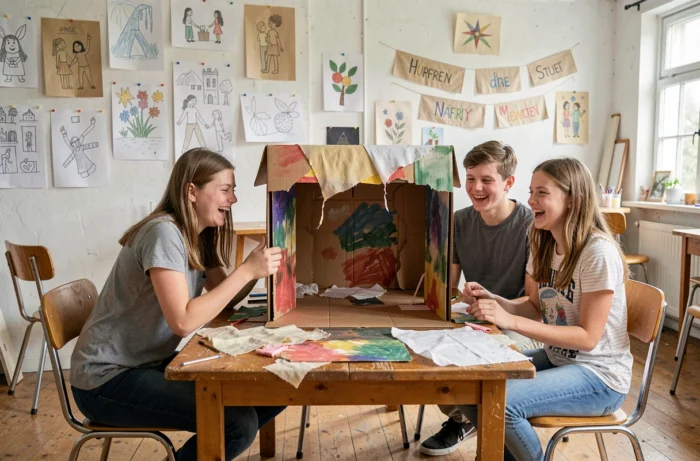
The Ministry of Culture has highlighted the “Cultural Vacations” operation, which transforms certain summer camps into places of creation where artistic practices are placed at the heart of the stay. This trend, on the rise for several years, marks a paradigm shift: leisure time becomes making time.
The Pass Culture has also opened up new eligible areas, notably design, crafts, and scientific and technical culture. This extension promotes more offbeat creative practices: making workshops, interactive installations, digital arts. These formats go beyond the classic offering centered on books, cinema, or live performances.
The programming workshop proposed by the Cultural Center of Huy with “Les Enfants Terribles” illustrates this hybridization. The child does not watch: they code, assemble, and test. The offbeat lies in the method, not just in the theme.
Humor, absurdity, and inverted world: the springs of the offbeat in youth
What distinguishes an “enfant terrible” universe from a conventional youth offering lies in a few recurring springs:
- Role inversion: the child is smarter than the adult, the small animal dominates the predator, the fragile character solves the problem that the strong cannot handle.
- Embraced absurdity: situations do not seek plausibility but surprise, freeing the imagination from the realistic frame.
- Humor as a tool for distance: laughing at a frightening situation allows the child to tame it without denying it.
These mechanisms are not decorative. They structure a relationship to the world where imagination serves as a tool for understanding, not simply entertainment. The offbeat universe of the enfants terribles offers an alternative reading grid, where creativity is not an added soul but an active skill, mobilized in response to each story, each page, each scene.