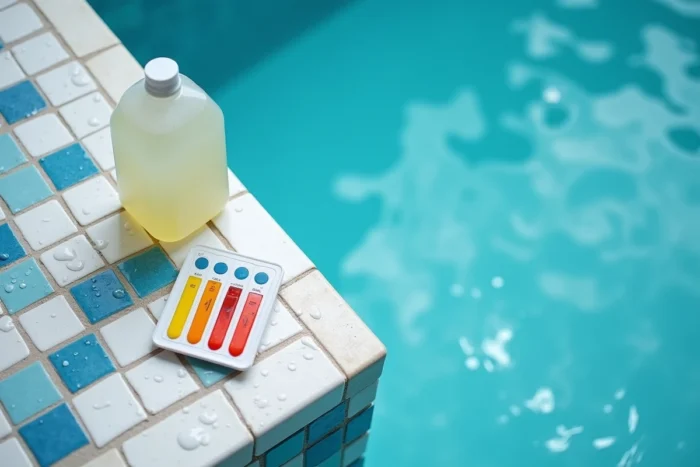
We open the technical room after a few days’ absence, and the smell is quite strong, with the colorimetric test turning dark purple. The diagnosis is clear: too much bleach in the pool. This situation occurs more often than one might think, especially when bleach is poured directly into the skimmer without measuring the actual concentration of the water. The consequences affect both swimmers, the equipment, and the chemical balance of the pool.
Bleach and free chlorine: why pH changes everything in case of overdose
Bleach (sodium hypochlorite) releases active chlorine when it comes into contact with water. Its effectiveness directly depends on pH. When bleach is overdosed, the pH often rises above 8, sometimes even higher.
At this level, active chlorine loses a significant portion of its disinfecting power. You end up with a high total chlorine level, but a very low biocidal free chlorine level. The water smells strong, the strips show an excess, and yet the disinfection is poor.
This is a common trap: more bleach is added thinking it was underdosed, while the problem actually lies with the pH. Before correcting an overdose, simultaneously measuring pH and free chlorine helps avoid an excess of chemical products. Understanding the risks associated with bleach overdose helps to make the right diagnosis before intervening.
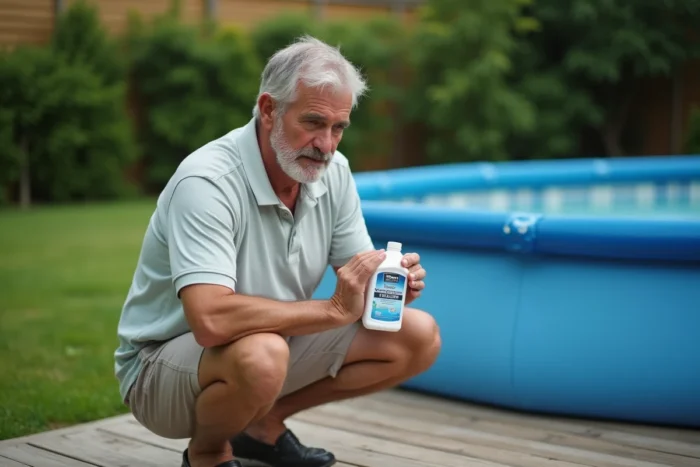
Another point confirmed by field reports: commercial bleach (with varying concentrations depending on the containers) does not have the same active chlorine content as calcium hypochlorite or stabilized chlorine tablets. Measuring “by the cap” without knowing the product’s concentration is the primary cause of overdose in private pools.
Symptoms of bleach overdose on swimmers
The first signs often appear during or just after swimming. They are sometimes confused with simple skin sensitivity, but their combination should raise alarm bells.
Skin and eye reactions
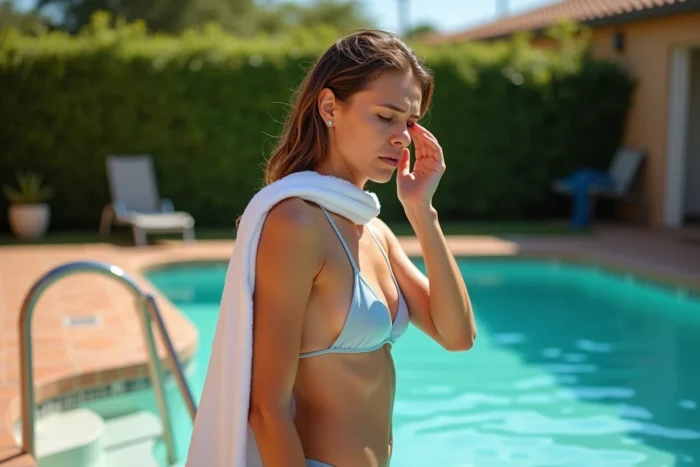
The skin reddens, tightens, and sometimes itches. The eyes sting even with swimming goggles, as chloramines (by-products of chlorine combined with organic matter) irritate the mucous membranes. In children and people with sensitive skin, redness can persist for several hours after leaving the water.
Respiratory pathways: the underestimated risk
Above an overdosed pool, chlorine vapors stagnate at the surface, especially when the water is warm or the pool is covered. One then breathes in gaseous dichlorine and trichloramines.
The Belgian Poison Control Center reports that these acute exposures to chlorine vapors can cause bronchospasms and delayed pulmonary edema. The recommendation is clear: a minimum of 24 hours of medical monitoring after significant inhalation, even if the initial respiratory discomfort seems mild.
Children, asthmatics, and the elderly are at increased risk. If someone has a persistent cough, feels chest tightness, or has difficulty breathing after swimming, immediately remove the person from the pool area and call the poison control center or 15.
Damage to equipment and pool liner
Bleach overdose affects not only swimmers. The pool itself suffers.
- The PVC liner discolors in patches and loses flexibility, which accelerates its aging and promotes micro-cracks at the seams.
- The tile joints, skimmers, and plastic parts (jet covers, baskets) whiten and become brittle after repeated exposures.
- The pump and sand filter see their metal components (screws, springs, seals) corrode faster when the chlorine level remains high for several days.
A one-time overdose leaves few traces, but repeated episodes reduce the liner’s lifespan by several seasons. In pools with submerged roller covers, the polycarbonate slats dull and weaken due to concentrated chlorine.
Correcting excess chlorine in the pool: field protocol
Do not swim until the free chlorine level has returned to the recommended range. Here is the concrete procedure to follow.
Dilution and aeration
The first action, the simplest, is to stop all addition of chlorinated products and run the filtration continuously. If the pool allows, partially drain (one quarter to one third of the volume) and refill with fresh water. Exposure to UV rays from the sun naturally degrades free chlorine, provided the water does not contain too much stabilizer (cyanuric acid).
Chemical neutralizer: sodium thiosulfate
When dilution is not enough or the pool is covered, sodium thiosulfate neutralizes excess chlorine. It should be dosed gradually, retesting the water every hour, as an overdose of the neutralizer would drop chlorine to zero and leave the pool unprotected.
It depends on the installation: for a small above-ground pool, dilution alone may suffice within a few hours. For a pool larger than 50 m³ with a high stabilizer level, thiosulfate becomes almost essential to bring levels down in a reasonable time frame.
Verification before swimming
- Free chlorine has returned to the range recommended by the product manufacturer.
- pH corrected if bleach has raised it (a pH reducer may be necessary).
- Absence of strong odor at water level, indicating that chloramines have decreased.
Emergency actions in case of chlorine ingestion or inhalation
A child who swallows several gulps of heavily chlorinated water or a person exposed to concentrated vapors requires prompt attention.
The French Society of Emergency Medicine (SFMU) strongly advises against administering so-called “neutralizing” drinks like milk, vinegar, or baking soda. These mixtures can worsen caustic injuries or cause gas release in the stomach. The current recommendation is limited to mouth rinsing and a quick medical assessment.
Call the poison control center (available 24/7) or 15 to describe the situation. Do not induce vomiting. Remove the person from the exposure area and place them in a calm, open-air environment.
Since the COVID-19 pandemic, French and Belgian poison control centers have reported an increase in calls related to accidental exposures to bleach and chlorinated disinfectants, partly due to inappropriate use in private pools. This observation reinforces the need for rigorous dosing and separate storage of chemical products, away from children and heat sources.