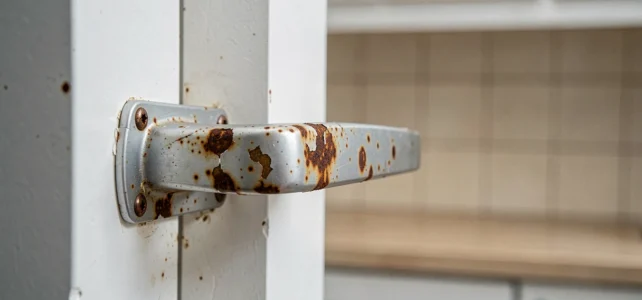
A refrigerator that still works can already pose a problem if its body or internal components show signs of rust. The corrosion of a refrigerator is not just an aesthetic defect: it affects the sealing, thermal regulation, and safety of the stored food. Measuring the actual extent of these risks helps decide whether to treat, repair, or replace the appliance.
Corrosion of the fridge and internal temperature: what the readings show
Rust primarily attacks the door seals, hinges, and interior walls when the protective coating is damaged. Each point of corrosion weakens the thermal insulation and the door’s sealing.
A study conducted in 2024 with members of ANSES showed that the majority of household refrigerators exceed the recommended 5 °C. On a rusty appliance, the problem worsens: micro-cracks in the seal continuously allow ambient air to enter.
| Area of the fridge affected by rust | Consequence on operation | Associated food risk |
|---|---|---|
| Door seal | Loss of sealing, entry of warm air | Break in the cold chain, bacterial proliferation |
| Interior wall | Deposit of iron oxide particles on food | Contamination by direct contact |
| Condenser (back) | Reduced heat dissipation, compressor overheating | Unstable temperature, warm areas in the fridge |
| Metal shelves | Structural weakening, flaking | Metal fragments in contact with food |
When the condenser located at the back rusts, heat dissipates less effectively. The compressor runs longer, the temperature fluctuates, and some areas of the fridge exceed the safety threshold of 4 °C, beyond which listeria actively develops.
Understanding the dangers of a rusty fridge helps assess whether a simple cleaning is sufficient or if the appliance has reached a structural point of no return.

Rust and bacteria: the link that common hygiene does not correct
Cleaning a refrigerator every month is a standard recommendation. On a rusty surface, this operation loses effectiveness. Rust forms a porous surface where bacteria embed in micro-cavities inaccessible to a sponge or cloth.
Food placed directly on a corroded shelf absorbs iron oxide particles. On raw meat or soft cheese, these deposits create a breeding ground for pathogenic bacteria responsible for food poisoning.
Critical areas often overlooked
- The vegetable drawer: the moisture from fresh vegetables accelerates the corrosion of the metal underneath the drawer, creating a reservoir of mold and rust invisible from the outside
- The condensate drainage channel: when it rusts, stagnant water becomes a bacterial culture medium that wicks back into the fridge
- The screws and fasteners of the door balconies: their corrosion weakens the support of the shelves and allows particles to fall onto the food stored below
The Ministry of Agriculture reminds us that one-third of foodborne illnesses occur at home according to ANSES. A fridge with corroded internal surfaces multiplies this risk because cleaning does not restore a pitted metal surface.
Rusty fridge in a humid or coastal environment: accelerated degradation
Poorly ventilated kitchens, seaside homes, and rooms exposed to high humidity subject the refrigerator to conditions of accelerated corrosion. Salty air attacks the fins of the condenser, the welds, and all peripheral metal parts.
User feedback from tropical or coastal areas shows that rust on the condenser causes repeated breakdowns and forces replacement of the appliance well before its theoretical lifespan. An anti-rust treatment applied to the condenser can slow the process, provided it does not block heat dissipation.
Factors that accelerate refrigerator corrosion
Cooking steam not evacuated by a hood, water splashes near the sink, and a humidity level above normal in the room are among the most common causes. In these environments, rust can appear within a few months on a new appliance if conditions are not corrected.
Since July 2026, the European directive on the right to repair applies to refrigerators. It mandates a parts availability duration of 5 to 10 years depending on the component. A fridge with a rusting condenser is therefore a maintenance issue governed by regulations, not just a visual inconvenience.
When to replace a rusty fridge: decision criteria
Superficial rust on the outer body alone does not justify replacement. However, several signals indicate that the appliance compromises food safety.
- The internal temperature regularly exceeds 5 °C despite a correctly set thermostat: the seal or insulation is likely degraded by corrosion
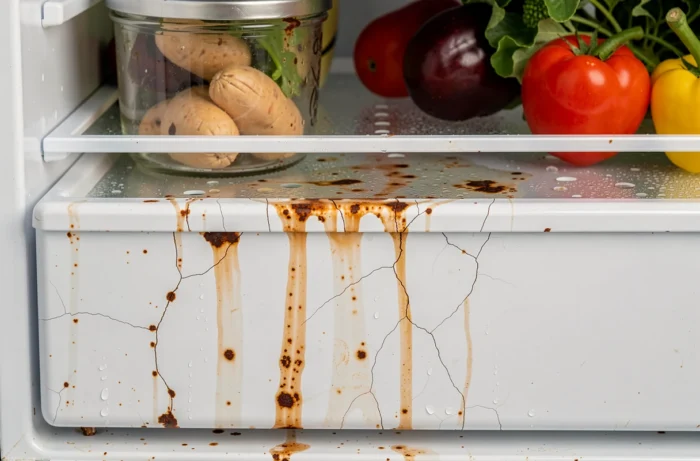
- Rust spots appear inside the compartment, on the walls or shelves: direct contact with food creates a contamination risk
- The compressor runs almost continuously: a corroded condenser no longer dissipates heat, leading to excessive electricity consumption and premature motor wear
- A brownish liquid leaks under the appliance: it may be a mixture of condensate and rust from degraded internal components
A thermometer placed in the fridge allows you to check if the temperature remains stable below 4 °C. This is the simplest and least expensive test to assess whether the appliance still fulfills its preservation function.
The corrosion of a refrigerator progresses without visible signals until the temperature goes awry or a component fails. Checking the condition of the seals, condenser, and internal surfaces once per season remains the most reliable way to anticipate a failure before it affects the safety of the stored food.