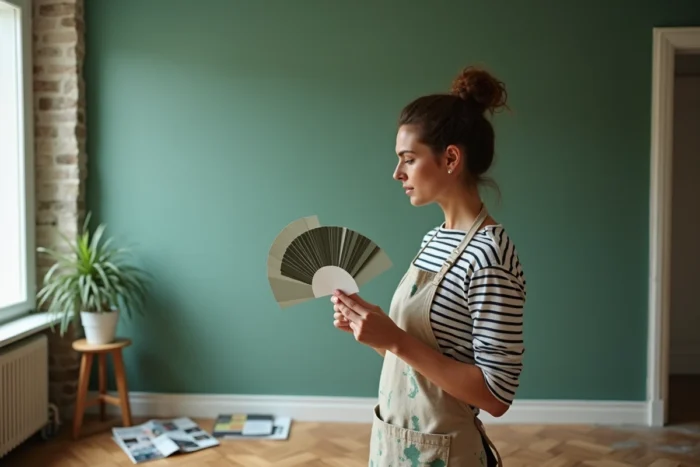
An interior that works relies on precise technical choices, not on an accumulation of trends. The real lever to transform your interior with style often lies in three poorly mastered parameters: the quality of the air conditioned by materials, the colorimetric coherence between surfaces and furniture, and the management of natural and artificial light flows.
Indoor air quality and material choices for decoration
Since 2024, French and European regulatory requirements on VOC emissions (volatile organic compounds) have tightened. The labeling of paints, adhesives, and coatings now requires checking the emission class before any purchase. An interior transformed with poorly rated materials degrades air quality over several months.
We recommend systematically selecting finishes rated A+ for VOC emissions. This applies to wall paints, wood varnishes, flooring adhesives, and particle boards used in furniture.
Ventilation plays a complementary role. A decoration project that modifies volumes (adding partitions, closing a mezzanine, creating a workspace) must include a check of the air renewal rate, especially in hybrid rooms that combine prolonged presence and new materials.
Solid wood coverings, unglazed terracotta, or genuine linoleum (made from linseed oil) are among the low-impact options for indoor air, while offering a wide aesthetic palette for personalized arrangements.
Colors and colorimetric coherence in a living room
The most common mistake in interior decoration is choosing a wall color in isolation, without considering the temperature of the lighting or the undertone of the existing furniture. A bluish gray on a wall can turn purple under warm dominant LED lighting. Colorimetric coherence is always verified on-site, under the actual lighting of the room, never in-store.
For living spaces (living room, open kitchen, dining room), we observe that a limited palette of three to four shades is sufficient to structure the atmosphere. The approach based on value contrasts (light against dark) takes precedence over chromatic variety. A living room entirely treated in neutral tones but with a marked contrast between the dark floor and light walls creates a visual depth that ten colors would not provide.
Generative AI tools integrated into software like Planner 5D now allow simulating the application of a palette on a 3D plan of your room. These color simulations help validate a choice before purchase, taking into account the actual proportions of the space and the position of openings.
To delve deeper into style associations and find decorative objects suited to a targeted palette, a useful resource: https://www.ambiance-et-deco.fr/ offers a catalog organized by ambiance universe.
Hybrid rooms and the layout of a multifunctional space
The single-function room is an outdated model in most French interiors. Since the widespread adoption of remote work, surveys conducted by the National Council of the Order of Architects and UNSFA confirm an intensification of hybrid room projects combining work, leisure, and sometimes home sports.
The layout of a multifunctional space requires precise zoning. Three technical levers enable this:
- Localized acoustic treatment: an absorbing panel made of felt or wood fiber behind a workstation reduces reverberation without visually partitioning the room.
- Foldable or pivoting furniture: a wall-mounted drop-leaf desk frees up floor space in the evening, restoring a living room or guest bedroom.
- Segmented lighting: independent circuits (general ceiling light, adjustable desk lamp, indirect LED strip) allow switching from one function to another without altering the furniture arrangement.
The choice of flooring also contributes to zoning. A low-pile rug under the work area, placed on continuous flooring, is enough to visually delineate the office space without material disruption.
Upcycling furniture and integrating reused pieces
The reuse of furniture is no longer a matter of approximate DIY. Upcycling has become a fully-fledged design axis in custom interior architecture projects, as documented by several French studios in professional press since 2023-2024.
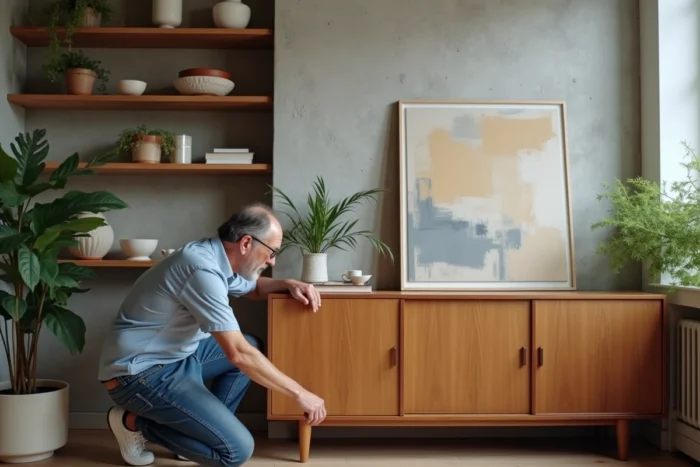
The interest goes beyond the ecological dimension. A vintage dresser that has been refinished in a specific tone creates a focal point that standardized new furniture does not produce. The uniqueness of a reused piece, with its proportions, controlled wear, and original hardware, brings a narrative texture to the decor.
The technical constraints to anticipate:
- Check the compatibility of old paints with new finishes (risk of blistering on unstripped lead paints).
- Control the structural stability of assemblies, especially on drawer furniture and table legs.
- Prefer low-emission finishing products to avoid negating the health benefits of reuse with a polluting varnish.
An antique piece restored with suitable techniques can last several additional decades. The cost of careful restoration is often lower than the purchase of a new piece of equivalent quality.
Layered lighting and the art of light in a living room
Layered lighting involves overlapping three light levels: general lighting (ceiling light, pendant), functional lighting (reading lamp, desk lamp), and accent lighting (adjustable spots on a piece of art, LED strip behind furniture). A well-lit living room uses at least these three layers.
Color temperature deserves special attention. For a living space, we recommend staying below 3,000 kelvins for ambient lighting, while maintaining a source at 4,000 kelvins for reading or work areas. Mixing sources with very different temperatures in the same visual field creates discomfort that the brain identifies without being able to name it.
Dimmers remain the most cost-effective device for transforming the atmosphere of a room without altering a single piece of furniture. The same living room can transition from a bright workspace to a cozy relaxation area in seconds.
The transformation of an interior with style relies on these technical choices, much more than on the selection of a cushion or a vase. Mastering light, air, and materials gives each decorative decision a solid foundation, the one that makes the difference between a decor that looks good in photos and a space where one lives well every day.