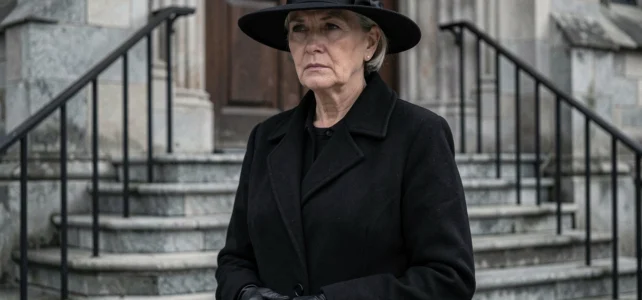
The hat worn at funerals is not a fashion accessory. Its status oscillates between strict religious prescription and a remnant of a fading social code, depending on the rite, location, and generation of the participants. In France, there is no legal obligation governing the wearing of headgear at funerals, but implicit expectations persist in certain family and confessional circles. Understanding these nuances helps avoid missteps on the day the question arises.
Hat at funerals: what each confession really expects
Competitors often treat the subject as a uniform block. The reality is more fragmented. The prescriptions vary so much from one rite to another that a gesture perceived as respectful in one ceremony can become inappropriate in another.
In Catholic and Anglican parishes, recent etiquette guides confirm that veils or hats are no longer required for women, even at funerals. What was once a mandatory practice has turned into a personal choice.
The situation is radically different at Jewish Orthodox funerals, where headgear remains mandatory for men (kippah or other head covering). Women must keep their arms and legs covered, although wearing a veil is not systematically imposed.
The case of Sikh funerals deserves special attention: headgear is explicitly requested from all participants, regardless of their religion. The gurdwara typically provides a scarf or bandana to those who arrive bareheaded. Not complying is seen as disrespectful to the entire community.
For Muslim funerals, women are encouraged to wear a headscarf covering their hair, and men may wear a cap. Knowing the hat rules for a funeral according to each tradition helps avoid a faux pas that could be misinterpreted by the deceased’s family.
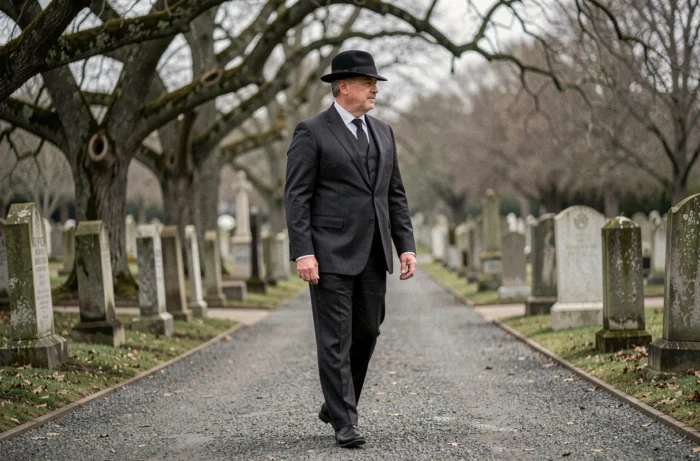
Man or woman: the rule of removing the hat does not apply the same way
A common confusion concerns when to remove one’s hat. The traditional rule that a man uncovers his head upon entering a Christian place of worship does not apply to women. Historically, women kept their hats on inside the church, while men were required to remove theirs.
This asymmetry persists in contemporary etiquette, even if it surprises. A man wearing a felt hat or fedora at a Catholic ceremony will remove it upon crossing the threshold. A woman wearing a hat with a veil or a fascinator may keep it on throughout the celebration.
Field reports diverge on this point when the ceremony is held outdoors, in a cemetery or a memorial garden. Some families believe that the rule of the place of worship extends to the cemetery, while others do not. In the absence of clear instructions, observing the behavior of the close family remains the most reliable guide.
Color and shape of the hat for a funeral: the limits of systematic black
Black remains the default color for mourning attire in France and most Western countries. For hats, this convention is almost always verified, but there are exceptions.
- Charcoal gray and navy blue are accepted in most secular or Catholic ceremonies, provided the shade remains dark and the material understated.
- White is worn in certain traditions, particularly during funerals in West African or Caribbean cultures, where it symbolizes the passage to the afterlife rather than mourning.
- Bright colors should be avoided in a classic Western context, unless explicitly requested by the family (some “celebration of life” ceremonies encourage colorful attire).
Regarding shape, a hat with moderate brims remains the safest choice. Very wide brims pose a practical problem: they obstruct the view of people sitting behind in a church or crematorium. Smaller fascinators and discreet hats are suitable for women who wish to make a gesture without taking up visual space.
For men, a soft-brimmed felt hat or a dark fabric flat cap are the most common options. Sports caps or bucket hats are still perceived as too casual for the occasion.
Post-Covid effect on funeral dress codes
Health restrictions have permanently altered habits. Reduced attendance ceremonies, often held outdoors or via videoconference, have relaxed dress expectations for several years. This relaxation has not fully dissipated: many families now adopt a more flexible code than before the pandemic.
The available data does not allow us to conclude whether this easing is permanent or temporary. However, funeral professionals observe that requests for personalized ceremonies (music, free attire, unusual venues) continue to rise. In this context, the question of the hat arises differently: it becomes a deliberate style choice rather than a social obligation.
When the hat is inappropriate
Some situations render wearing a hat counterproductive. If the family has explicitly requested casual attire, arriving with a ceremonial hat creates a mismatch. Similarly, in a closed space with a low ceiling (some crematorium rooms), a large head covering becomes a practical obstacle rather than a sign of respect.
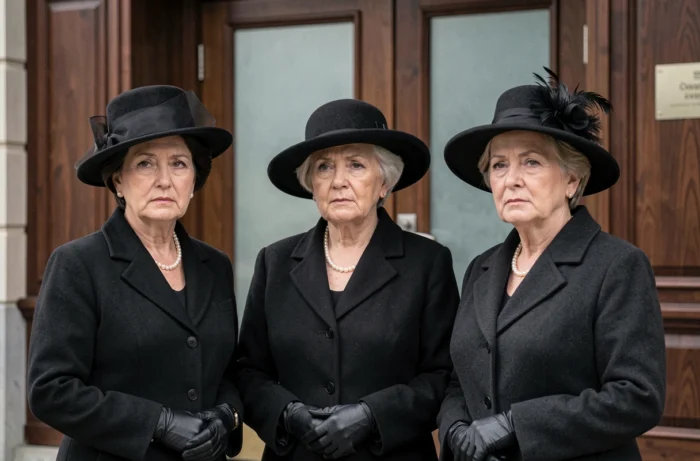
The most reliable point of reference remains direct communication with the family or the funeral organizer. A simple question asked in advance is better than a haphazard choice on the day itself. The hat at funerals is neither mandatory nor prohibited: it falls within a system of codes that varies according to confession, gender, and the family’s wishes. Wearing it discerningly means first knowing when it is expected and when it is better to forgo it.