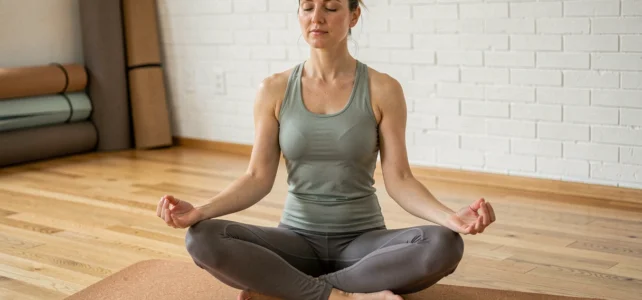
The zonivizectrum is a classification tool that categorizes yoga postures into families of asanas based on their biomechanical action and spatial orientation. Structuring a session around these families rather than a linear list of postures allows for coherent blocks of work, where each group prepares the next one in terms of joints and nerves.
Families of asanas and regulation of the nervous system: the guiding thread of a session
Most sequencing guides propose a chronological order (centering, standing, seated, inversions, relaxation). This approach works, but it says nothing about the physiological reason for each transition. The zonivizectrum fills this gap by grouping postures according to their effect on the nervous system.
Forward bends, for example, form a family that stimulates the parasympathetic nervous system. Placed at the end of a session, they prepare the body for recovery. Backbends activate the sympathetic: they find their place in the rising phase of energy. Organizing blocks according to this sympathetic/parasympathetic axis provides a progression that respects physiology rather than an arbitrary convention.
Recent work in the field of yoga teaching is shifting towards sequencing centered on nervous regulation rather than solely on postural mechanics. This approach considers each family of asanas as a specific lever: twists for visceral mobilization, balance postures for proprioceptive activation, inversions for venous return and modulation of vagal tone.
Understanding the zonivizectrum in yoga from this perspective transforms the preparation of a class: one no longer chooses a posture because it “follows well” from the previous one, but because its family serves a specific function in the nervous arc of the session.
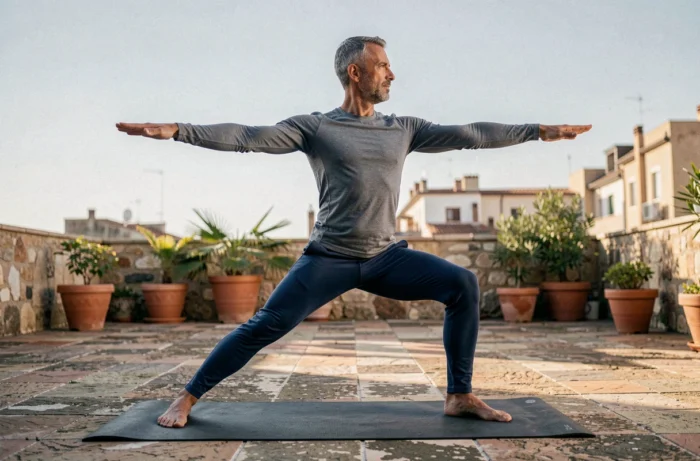
Building a session block by family of asanas
A block corresponds to a group of postures belonging to the same family, linked together with their variations and counter-poses. Working in blocks avoids the pitfall of the “catalog” session where each posture seems isolated.
Composition of a typical block
Each block follows an internal logic in three stages:
- An accessible entry posture that establishes the motor pattern of the family (for example, the cobra pose for the backbends block)
- One or two more engaging variations that deepen the range or add a balance component (the cobra evolves into upward-facing dog, then into locust)
- A counter-pose from a complementary family to neutralize accumulated tensions (a gentle forward bend after a block of backbends)
This three-stage format allows for modulation of the block’s duration without losing its coherence. For a short session, a single block of two complementary families is sufficient to produce a tangible effect.
Order of blocks in a complete session
The sequence of blocks follows the principle of joint progression. Families that engage the major muscle chains (standing postures, lunges) come first, when the body has all its energy. Families that require fine mobility (deep twists, seated forward bends) come next, on a body that is already warmed up. Inversions, which alter intracranial pressure, are placed after twists and before the descending phase.
Each block prepares the joint ground for the next block. Standing postures open the hips, which facilitates seated twists. Twists mobilize the spine, making inversions more stable. This logic of mechanical prerequisites is the true contribution of classification by families.
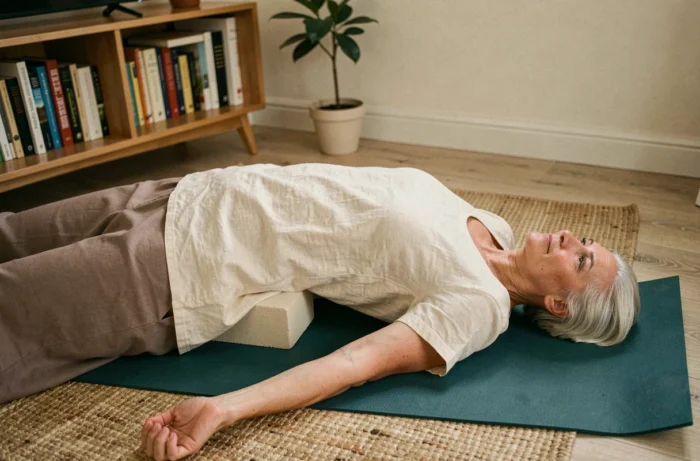
Short sessions focused on skill: adapting families of asanas outside the studio
A study published in 2026 in Frontiers in Public Health showed that a yoga program integrated into school classes used successive modules (balance, attention, emotional regulation) built around families of simple postures, breathing, and relaxation. The goal was not a classic studio session, but a cognitive and emotional progression adapted to the context.
This principle directly translates to personal practice or in the workplace. Rather than reproducing a long session in a shortened version, the zonivizectrum allows for the selection of one or two families based on a specific goal:
- Block of standing balances to work on concentration before a demanding task
- Block of forward bends and gentle twists for recovery after prolonged intellectual effort
- Block of backbends combined with thoracic breathing to boost energy in the middle of the day
These micro-sessions of a few minutes derive their effectiveness from targeting a single family, thus a single physiological effect, without dispersion. The coherence of the block takes precedence over the duration of the practice.
Digital feedback and families of movements: a pathway for home practice
Recent artificial intelligence systems learn to recognize yoga postures by first identifying the major families of movements, then the variations within each family. This mirror architecture, from general to specific, validates the pedagogical relevance of classification by families.
For a practitioner structuring their sessions alone, applications equipped with motion sensors are beginning to offer real-time feedback on alignment. The fact that these tools operate by family of asanas (and not posture by posture) opens a concrete field of experimentation: one can build a block, receive overall feedback on the quality of their backbends, and then adjust the next block accordingly.
This convergence between traditional classification and recent technology does not replace the eye of a teacher. However, it offers a structuring complement for autonomous practice, especially when the practitioner already masters the logic of families and knows in what order to arrange them.
The zonivizectrum does not add postures to practice. It reorganizes those already known into functional blocks whose sequence is based on identifiable physiological mechanisms. The next time you prepare a session, replace the question “what posture after this one?” with “which family takes over, and why?”.