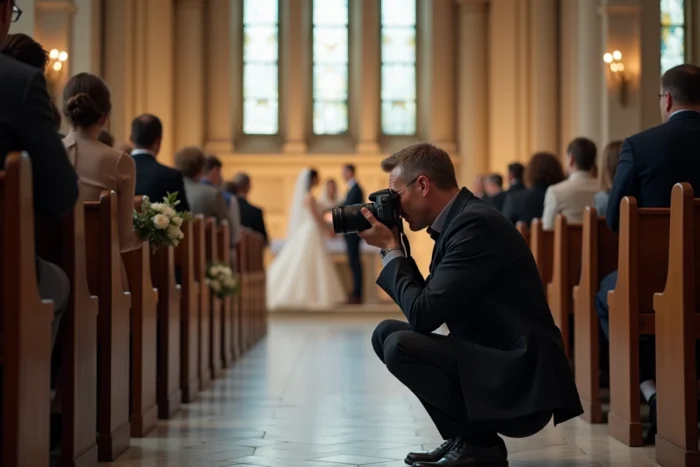
The distinction between official photo and candid photo at a wedding does not depend on the spontaneous or posed nature of the image. It is based on the contractual framework that binds the commissioned photographer to the couple. A snapshot taken spontaneously by the provider, with minimal light direction, remains an official photo.
A carefully composed portrait captured by a guest with a DSLR remains a photo outside the contractual framework. Confusing the two generates disputes over distribution, copyright, and image rights.
Contractual Clause: Define the Official Wedding Photo Before the Big Day
We recommend including an explicit definition of what constitutes an official photo included in the report in the service contract. Without this clause, ambiguity arises as soon as the photographer delivers documentary-style shots that visually resemble what a guest might have captured.
The most effective wording describes the official photo as any image taken by the commissioned photographer within the defined temporal and geographical scope of the contract, regardless of the degree of staging. This covers posed portraits, group photos, candid moments captured by the provider, and semi-staged images where the couple is simply placed in specific lighting and then left to interact freely.
The clause should also specify the fate of photos taken by guests. Several options exist: prohibition of photography during the ceremony, tolerance with restrictions on social media distribution, or complete freedom. This contractual framing is the only reliable lever to differentiate official and candid photos in a context where visual rendering alone is no longer sufficient.
Post-production and Colorimetry: The Most Reliable Technical Indicator
The documentary style blurs visual references. A professional photographer working in pure reportage delivers images that resemble snapshots. The difference is not found in composition or posing, but in the consistency of post-production across the entire report.
An official batch presents uniform colorimetry: same tones, same white balance, same type of cropping, same light treatment from one image to another. This homogeneity results from presets applied in series and then individually refined. A guest shooting with a smartphone or compact camera does not replicate this consistency.
What the Absence of Homogeneous Treatment Reveals
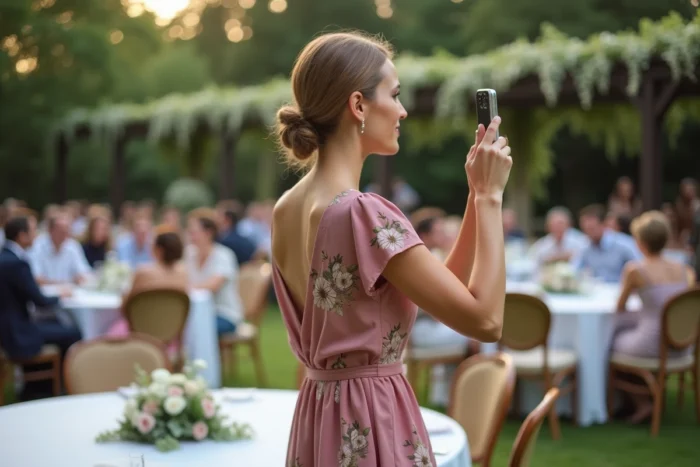
A candid photo taken by a guest is often identifiable by an uncorrected automatic rendering. The white balance varies from shot to shot, digital noise is not reduced, and highlights are blown out without recovery. If you receive an isolated image whose color treatment differs from the rest of the delivered gallery, it likely does not belong to the official report.
We also observe that some photographers incorporate a discreet watermark or customized EXIF metadata (copyright, camera serial number) in their files. Checking this metadata remains the quickest technical means to authenticate the origin of an image.
Semi-staged Photo: The Gray Area of Wedding Reporting
The most frequent confusion concerns candid moments delivered by the photographer. Many couples discover images in their gallery that they do not remember posing for. Some attribute them to a guest or label them as “candid” when they are part of the official report.
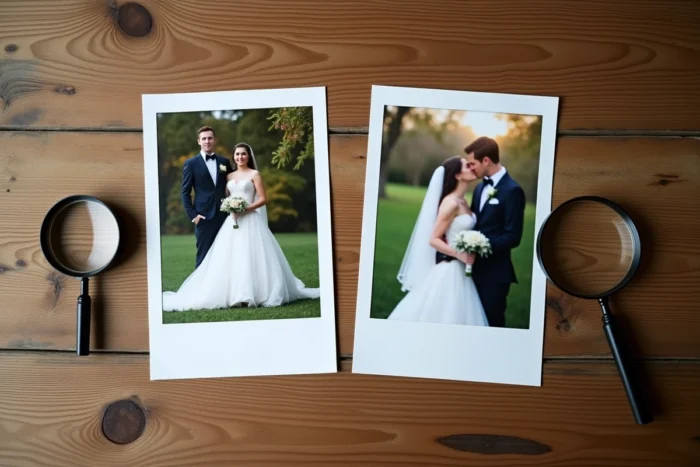
In practice, many of these shots are semi-staged by the photographer. The technique involves guiding the couple to favorable lighting (window, backlight, natural light at the end of the day) and then allowing them to interact without posing directives. The result appears to be a spontaneous moment, but the light direction and framing are professional.
This approach renders the reading grid “posed = official, spontaneous = candid” obsolete. The relevant criterion is not the degree of spontaneity visible in the image, but the identity of the person who triggered the shot and the contractual framework in which they operated.
Communicating the Rules to Guests: Photo Protocol on Wedding Day
Defining the official photo contractually is not enough if guests are unaware of the limits. A clear protocol, communicated in advance, reduces misunderstandings about image distribution.
- Specify in the invitation or on the wedding website whether smartphones are allowed during the ceremony, and if guest photos can be published on social media before the official report is delivered.
- Ask the master of ceremonies to announce the photo guidelines vocally before key moments (exchange of vows, exit from the ceremony, first dance).
- Create a shared album dedicated to guest photos, separate from the official gallery delivered by the photographer, to avoid any confusion about the origin of the images.
This protocol also protects the work of the commissioned photographer. A guest leaning into the aisle with a smartphone may appear in the provider’s frame and compromise a ceremony shot. The guideline benefits both the couple and the photographer.
Image Rights and Distribution of Guest Photos
Photos taken by guests raise a distinct legal question. The commissioned photographer operates under contract, and their deliverables are framed by copyright. Guest shots, on the other hand, fall under image rights: any person photographed can oppose the distribution of their image without consent.
We recommend including in the protocol a note reminding that publishing photos showing other guests requires their agreement. This reminder, even informal, limits situations where a candid photo ends up online without the consent of the represented individuals.
EXIF Metadata as Proof of Authenticity
In case of doubt about the origin of an image, EXIF metadata provides objective elements:
- The “Copyright” field filled out by the professional photographer in their camera or during post-production.
- The camera serial number, which allows identifying the camera used and cross-referencing it with the equipment declared by the provider.
- The precise timestamp, which confirms whether the photo was taken during the time frame covered by the contract.
- The processing software (Lightroom, Capture One) mentioned in the metadata, absent from raw smartphone files.
Checking the EXIF metadata resolves the question in seconds. Free tools allow reading this data on any JPEG or TIFF file. If the copyright field is empty, the camera is a smartphone, and the time does not match the contractual timeframe, the image does not belong to the official report.
The boundary between official photo and candid photo is not drawn by the naked eye. It is read in the contract, in the consistency of post-production, and in the file’s metadata. Establishing these benchmarks before the wedding avoids disputes afterward.