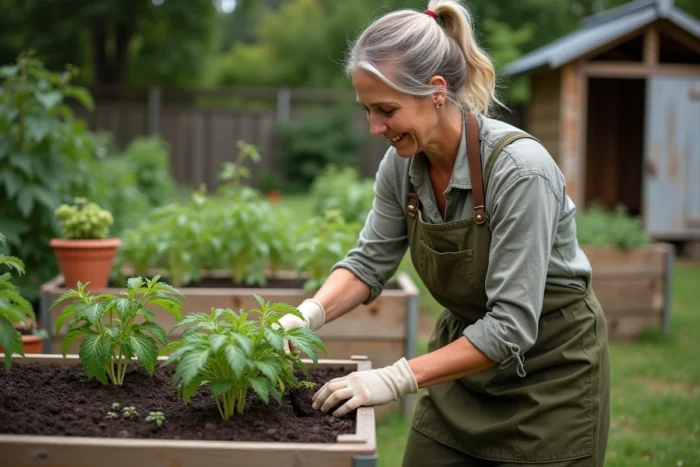
A vegetable garden that produces twelve months a year relies less on the amount of work and more on choosing the right levers at the right time. What parameters separate a productive garden all year round from one that slows down as soon as October? The balance between varieties, water management, and soil coverage provides most of the answer.
Comparison of yield levers in the vegetable garden by season
Not all actions carry the same weight depending on the period. The table below summarizes the relative impact of four levers on productivity, season by season.
| Lever | Spring | Summer | Autumn | Winter |
|---|---|---|---|---|
| Varietal choice (perpetual vegetables, hardy varieties) | High | Medium | High | Decisive |
| Thick mulching / permanent cover | Medium | Decisive | High | High |
| Watering management (water recovery, drip irrigation) | Medium | Decisive | Low | Low |
| Crop rotation and associations | High | High | Medium | Low |
The “Summer” column concentrates two decisive levers. It is the season when a poorly prepared garden falters, especially since drought orders limit or prohibit daytime watering in many French regions.
Approaching the vegetable garden according to Perspectives Jardin helps visualize how these levers fit into a coherent cultivation plan.
Mulching and water savings: the game-changing duo in summer
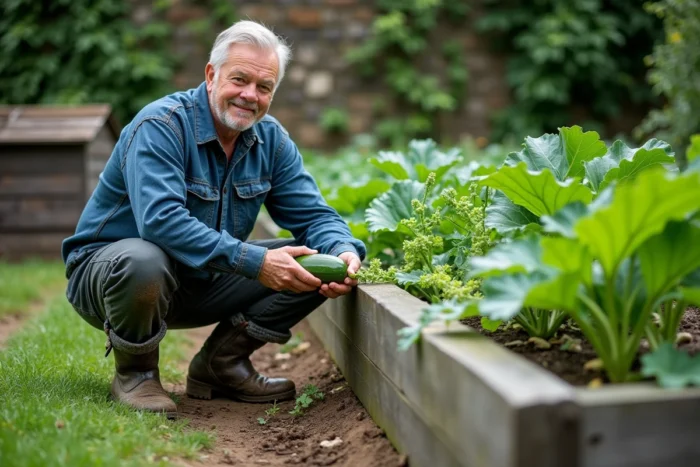
Since 2022, shared gardening networks have documented a clear transition towards techniques for drastic reduction of watering. Very thick mulching, like forest mulch, and permanent cover are no longer options reserved for permaculture enthusiasts. They have become a basic requirement for maintaining a productive garden during the hot months.
Why mulching outperforms watering in terms of summer yield
A bare soil exposed to the sun loses its moisture within hours. Adding massive watering does not compensate for this evaporation if the surface remains uncovered. In contrast, a sufficiently thick layer of organic mulch keeps the soil cool, nourishes microbial life, and limits the emergence of weeds.
The choice of mulch depends on what you are growing. Dried grass clippings are suitable for leafy vegetables. Branch chips (BRF) work better around tomatoes and squash, which prefer a more structured soil.
Anticipating water restrictions
Several local authorities (notably in Brittany and PACA) now encourage rainwater harvesting for garden watering. Installing a tank before summer allows for a legal reserve even during drought orders. Drip irrigation, connected to this tank, targets the root zone without waste.
- Thick mulching (several centimeters) applied as soon as late spring, before the first heat
- Rainwater harvesting tank connected to a low-pressure drip irrigation system
- Watering concentrated early in the morning or in the evening to reduce evaporation and comply with time restrictions
Perpetual vegetables and hardy varieties: growing beyond summer
The table above shows that varietal choice becomes decisive in winter when other levers lose their weight. Perpetual vegetables (sorrel, perpetual leek, Daubenton cabbage, sunchoke) produce without reseeding each year and tolerate the cold.
So-called drought-resistant varieties also deserve attention for the hot season. Among the examples documented by shared gardening networks: the Andean horned tomato, trailing squashes, and chickpeas, which require very little water once established.
Planning sowing to cover every slot
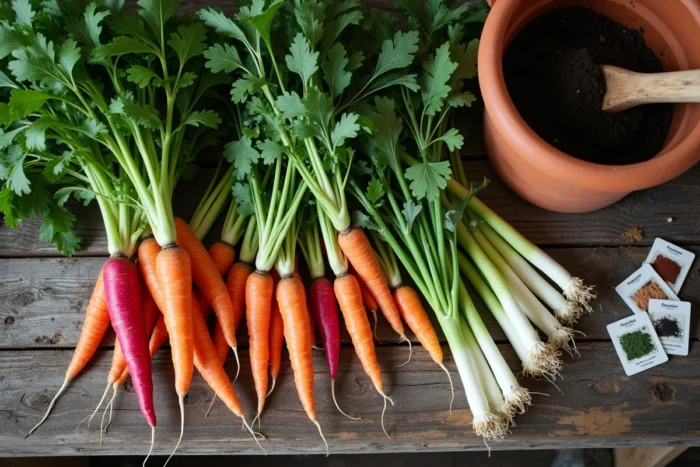
A productive garden all year round operates in relays. When tomatoes and zucchinis finish their cycle in September, sowings of lamb’s lettuce, winter spinach, and broad beans take over. Each freed bed must be reseeded or covered within the week to avoid bare soil that degrades.
Spring serves as a launch period for sowing under cover (cold frames, forcing covers), which advances the first harvests by several weeks. Autumn, on the other hand, is the time to plant garlic, onions, and shallots, which will overwinter in the ground with little maintenance.
Living soil and rotation: protecting yield over several years
A garden that runs all year exhausts the soil faster than a seasonal garden. Crop rotation over three or four zones remains the most reliable mechanism to avoid the accumulation of pathogens and soil fatigue.
The principle is simple: never grow the same botanical family in the same place two years in a row. Solanaceae (tomatoes, peppers, eggplants) give way to legumes (beans, peas, broad beans), which fix atmospheric nitrogen in the soil. Cucurbits follow, benefiting from this residual nitrogen.
- Zone A: solanaceae in year 1, legumes in year 2, cucurbits in year 3, root vegetables in year 4
- Zone B: shifted by one notch, so that each family migrates from one zone to another
- Green manures (mustard, phacelia) sown on any empty plot for more than three weeks
The soil also benefits from the permanent mulching mentioned above. A covered and organic matter-fed soil regenerates its fertility between two crops, which reduces the need for external inputs (compost, manure).
The difference between a garden that produces for one season and a garden that produces all year round lies in these balances: varieties suited to each slot, soil never left bare, water managed as a rare resource. These three parameters, combined with rigorous rotation, form the foundation of a garden that does not tire out.