Have you noticed a whitish or yellowish deposit on your armpit hair, accompanied by a persistent odor despite regular hygiene? It’s probably not a fungal infection. Axillary trichobacteriosis is a superficial bacterial infection of the hair, caused by corynebacteria, and not by a fungus. Its former name, “trichomycosis,” still causes confusion. Understanding what distinguishes it from other axillary dermatoses allows for quick action and avoids inappropriate treatments.
Trichobacteriosis or axillary mycosis: how to tell the difference with the naked eye
Many people treat their trichobacteriosis with an antifungal cream, convinced they have a fungal infection. The treatment fails, the odor persists, and the visit to the dermatologist comes too late. Learning to distinguish between these two conditions can save time and discomfort.
Here are concrete visual markers to differentiate the main axillary conditions:
| Criterion | Trichobacteriosis | Axillary mycosis | Contact dermatitis |
|---|---|---|---|
| Location | On the hair itself | On the skin (folds) | On the skin (contact area) |
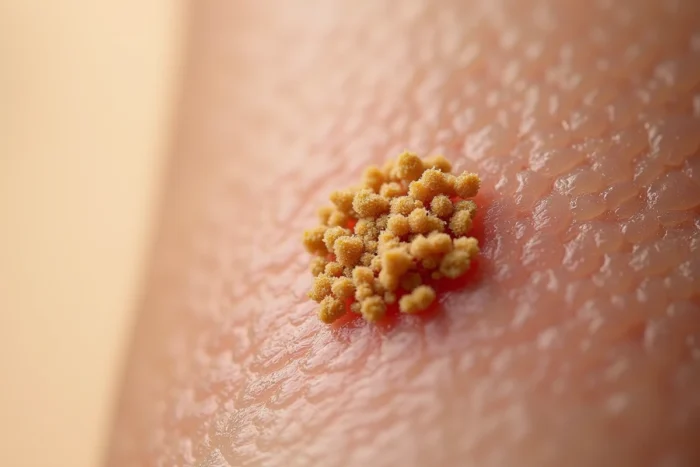
| Visual appearance | White, yellow, or orange concretions encasing the hair shaft | Red plaques, scaling, sharp edges | Diffuse redness, possible vesicles |
| Itching | Absent or very mild | Frequent, sometimes intense | Frequent, burning sensation |
| Odor | Strong, sour, persistent after washing | Mild or absent | Absent |
| Underlying skin | Healthy, without redness | Inflamed, sometimes weeping | Irritated, red |
If the deposit is on the hair and the skin underneath appears normal, this is the most reliable sign of trichobacteriosis. An axillary mycosis, on the other hand, attacks the skin of the fold and leaves the hair intact. This simple distinction already helps direct towards an appropriate treatment for axillary trichobacteriosis rather than an unnecessary antifungal.
Corynebacteria and sweating: what causes axillary trichobacteriosis
Trichobacteriosis is not a matter of cleanliness. It results from the interaction between a favorable environment and bacteria already present on the skin.
Corynebacteria colonize the hair shafts by forming biofilms, these visible concretions that encase the hair. The mechanism is simple: these bacteria feed on sweat and sebum. The longer the area remains moist, the more they proliferate.
Factors that promote infection
- Excessive sweating (hyperhidrosis), worsened by hot or humid climates, such as in tropical areas
- Prolonged wearing of tight synthetic clothing that retains moisture against the skin
- Use of very occlusive deodorants or long-lasting antiperspirants, some film-forming polymers of which may prolong local moisture according to a series of cases published in 2022 in the International Journal of Trichology
- Insufficient shaving that leaves long hairs where bacteria can accumulate more easily
Young men are more often affected, particularly in contexts where daily hygiene is limited (military missions, prolonged physical work, intensive sports practice). However, the condition remains possible in anyone meeting these conditions.
Wood’s lamp and clinical diagnosis: when to consult a dermatologist
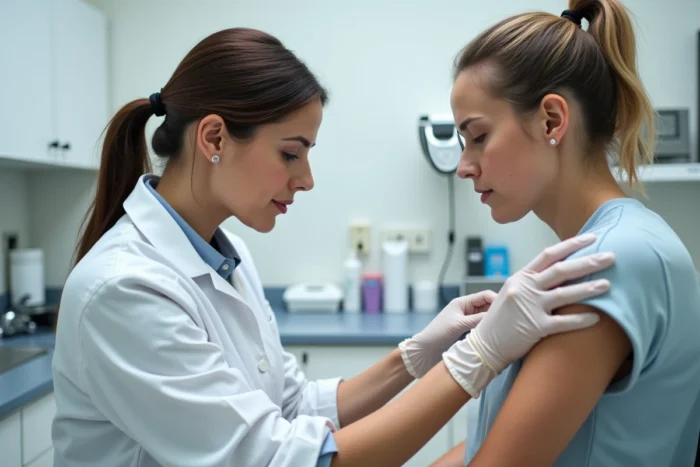
The diagnosis of trichobacteriosis is primarily visual. A trained physician quickly identifies the characteristic concretions on the hair. In case of doubt, a simple additional examination can confirm.
The Wood’s lamp produces a yellow to green fluorescence on the affected hairs. This tool, available in dermatology offices, illuminates the area with ultraviolet light. Hairs colonized by corynebacteria emit a distinct color, whereas a mycosis or simple irritation does not react the same way.
When to consult? If the axillary odor persists despite careful washing, if an antifungal treatment has yielded no results after two weeks, or if the concretions on the hair do not disappear with shaving alone, a dermatological opinion is necessary.
Treatment of axillary trichobacteriosis: shaving, antiseptic, and follow-up
Management relies on simple but combined actions. Neither of the two pillars of treatment is sufficient alone.
Shaving the axillary hairs
Shaving the affected hairs eliminates the majority of the bacterial biofilm at once. It is the most effective action in the short term. Without a hair support, corynebacteria lose their main proliferation medium.
Daily antiseptic cleaning
After shaving, daily washing with a foaming antiseptic complements the mechanical action. Products containing chlorhexidine or triclocarban are most often recommended. The application should last at least one minute on the area before rinsing.
Resistant cases
If the infection recurs despite these measures, a local application of topical antibiotic (erythromycin or clindamycin) may be prescribed by the physician. Antifungals, on the other hand, are of no use since the causative agent is a bacterium and not a fungus.
- Prefer clothing made of natural fibers (cotton, linen) to limit maceration
- Change tops at least once a day in case of heavy sweating
- Avoid very occlusive antiperspirants during the treatment phase
- Thoroughly dry the armpits after each shower before getting dressed
Axillary trichobacteriosis heals quickly when correctly identified. The real difficulty is not the treatment, which remains accessible, but the initial diagnosis. As long as this infection continues to be confused with a mycosis or reduced to a body odor problem, weeks of inappropriate treatment accumulate. A simple attentive look at the hair, and not the skin, is often enough to set things right.